
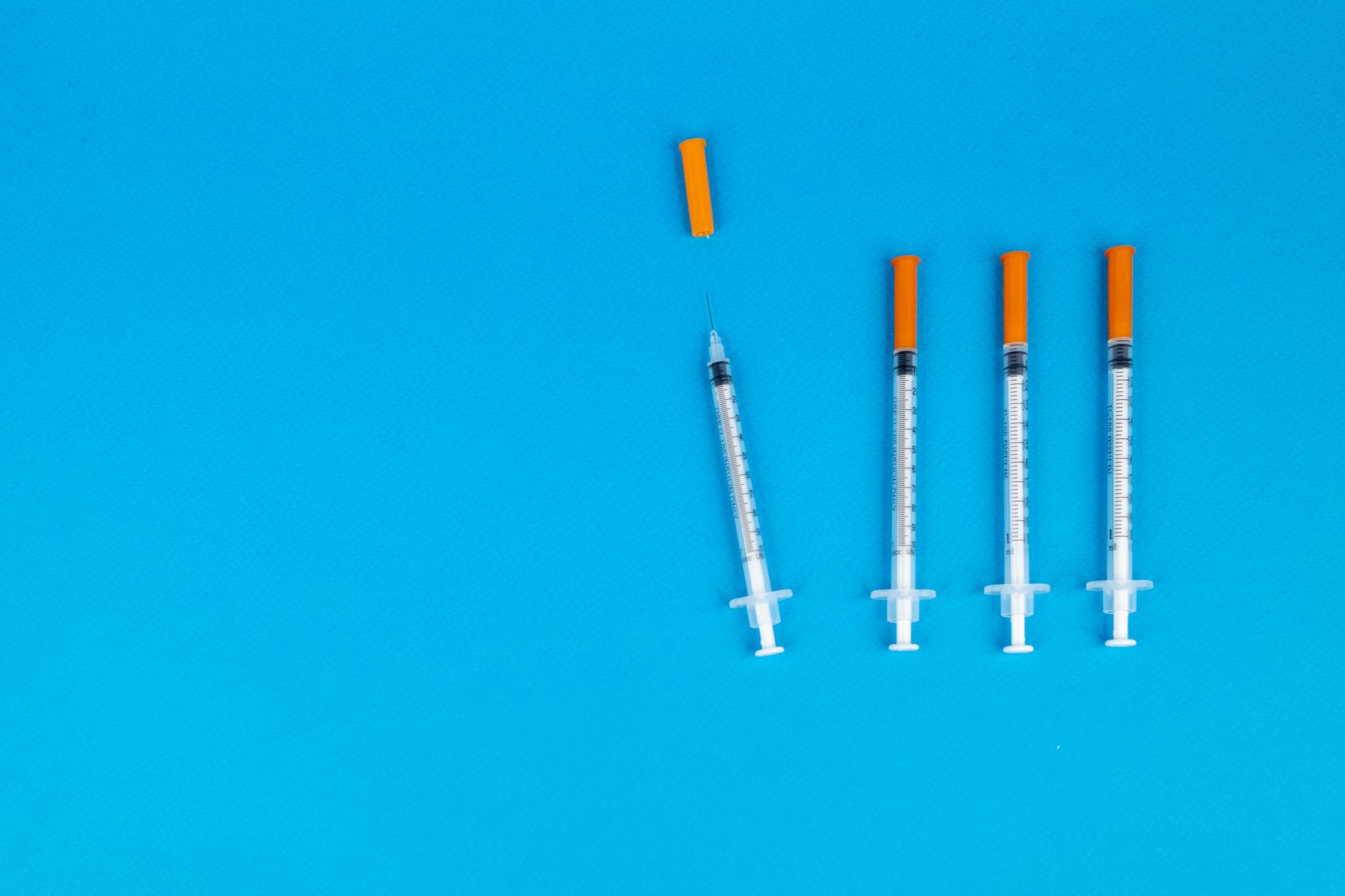
- On a U-100 insulin syringe, 100 units equals exactly 1 mL, so 1 unit equals 0.01 mL.
- The numbers printed on the barrel are insulin units (IU), not milligrams or micrograms of peptide.
- To convert a dose, you must know the concentration after reconstitution (micrograms per mL), which depends on how much bacteriostatic water you added.
- The core formula is: units to draw = (desired dose in mcg ÷ concentration in mcg per mL) × 100.
- The most common errors are confusing units with milligrams, misreading half-unit markings, and forgetting to recalculate when the reconstitution volume changes.
- A reconstitution calculator removes most arithmetic errors, but you should still understand the underlying math.
- This is educational content only — always consult a licensed healthcare professional before using any research peptide.
What Is a U-100 Insulin Syringe and Why Is It Used for Peptides?
If you have spent any time researching how research peptides are measured, you have almost certainly encountered the phrase "draw 10 units." That instruction refers to a specific, standardized piece of equipment: the U-100 insulin syringe. Understanding what the "U-100" designation means is the foundation for every conversion in this guide, so it is worth getting precisely right before touching any math.
The "U-100" label is a concentration standard, not a size. It means the syringe is calibrated for a fluid that contains 100 units per milliliter. This standard originated with insulin dosing, where insulin is manufactured at a strength of 100 international units (IU) per milliliter. Because insulin syringes are inexpensive, widely available, and marked in very fine gradations, they became the default tool researchers use to measure small volumes of reconstituted peptides.
It is critical to understand a subtle but important point: peptides are not supplied at 100 units per mL. The "units" on the barrel are simply volume markings borrowed from the insulin world. When you draw a reconstituted peptide into a U-100 syringe, each unit still represents the same fixed volume — one hundredth of a milliliter — regardless of what liquid is inside. The syringe measures volume; it has no way of knowing how much peptide that volume contains.
This distinction is the single most important concept in the entire guide. A "unit" is a measure of volume, while your actual peptide dose is a measure of mass (micrograms or milligrams). The bridge between the two is the concentration you created when you reconstituted the vial. If you understand nothing else, understand this: the number on the syringe tells you how much liquid you have drawn, not how much peptide.
Before going further, it helps to have a solid grounding in the underlying science. If you are new to this field, our overview of what peptides are explains why these molecules require careful handling and precise dosing in the first place.
How Do You Read the Units Printed on the Barrel?
A U-100 insulin syringe has three parts that matter for reading a dose: the barrel (the clear cylinder with printed numbers), the plunger (which you pull back and push forward), and the needle at the tip. The numbers you read are printed along the barrel, and you read the dose from the position of the rubber stopper on the end of the plunger.
On the most common 1 mL (100-unit) syringe, the barrel is typically marked in increments of 2 units, with longer lines and printed numbers at every 10 units: 10, 20, 30, and so on up to 100. Smaller syringes use finer gradations. A 0.3 mL (30-unit) syringe is often marked in 1-unit increments, and some are even marked in half-unit (0.5 unit) increments, which allows for far more precise measurement of small doses.
To read a dose correctly, hold the syringe at eye level with the needle pointing up and look at where the front edge of the rubber stopper sits relative to the printed lines. Reading from the wrong edge of the stopper, or looking at an angle, is a frequent source of error. If the stopper edge sits on the fifth line above the "10" mark on a syringe marked in 2-unit increments, you have drawn 20 units.
Take a moment before every measurement to identify the increment on your specific syringe. Do not assume every syringe is marked the same way — a 0.5 mL syringe marked in 1-unit steps looks very similar to a 0.3 mL syringe marked in half-unit steps, and confusing the two will double or halve your intended volume. Manufacturers vary, so read the packaging and count the small lines between two numbered marks to confirm the increment.
Finally, remember that air bubbles displace liquid. If a bubble occupies space between the stopper and the fluid, the volume of peptide you actually inject will be less than the number you read on the barrel. Tapping the syringe to bring bubbles to the top and expelling them before you finalize the reading is standard practice, and we cover the full technique in the best-practices section below.
How Do Units Relate to Milliliters (mL)?
The relationship between units and milliliters on a U-100 syringe is fixed, simple, and never changes. Because 100 units equals 1 mL by definition, every single unit equals 0.01 mL. This is the conversion factor you will use constantly, so it is worth memorizing in both directions.
To convert units to milliliters, divide the number of units by 100. To convert milliliters to units, multiply the number of milliliters by 100. That is the entire relationship. It does not depend on the peptide, the vial size, or the amount of bacteriostatic water you used — it is a property of the syringe alone.
| Units on U-100 syringe | Volume in mL |
|---|---|
| 5 units | 0.05 mL |
| 10 units | 0.10 mL |
| 20 units | 0.20 mL |
| 25 units | 0.25 mL |
| 50 units | 0.50 mL |
| 100 units | 1.00 mL |
Notice that these figures say nothing about how much peptide is present. Whether the vial contains a highly concentrated solution or a very dilute one, 20 units is always 0.20 mL. The amount of active peptide in that 0.20 mL is entirely determined by the concentration you created during reconstitution — which is the subject of the next section.
Because this volume-to-unit relationship is invariant, many researchers find it easiest to first calculate the volume they need in mL and then multiply by 100 to get units at the very end. Doing the mass-and-volume math first, and the unit conversion last, keeps the two concepts cleanly separated and reduces mistakes.
How Do You Convert a Peptide Dose into Syringe Units?
Converting a prescribed or protocol dose into syringe units is a two-step process. First you determine the concentration of your reconstituted vial, and then you calculate the volume that contains your desired dose. Only at the very end do you translate that volume into units.
Step one is to establish concentration. When you reconstitute a lyophilized (freeze-dried) peptide, you add a known volume of bacteriostatic water to a vial containing a known mass of peptide. Concentration is simply mass divided by volume. For example, a 5 mg vial reconstituted with 2 mL of bacteriostatic water yields a concentration of 2.5 mg/mL, which is the same as 2,500 micrograms (mcg) per mL. Converting milligrams to micrograms early (1 mg = 1,000 mcg) makes the later arithmetic cleaner, because most peptide doses are expressed in micrograms.
Step two is the master formula. To find how many units to draw for a given dose:
- Units to draw = (desired dose in mcg ÷ concentration in mcg per mL) × 100
The division gives you the volume in milliliters, and multiplying by 100 converts that volume into U-100 syringe units. You can also express this as a single mental shortcut: figure out how many micrograms are in each unit (concentration ÷ 100), then divide your dose by that number. Both approaches give the same answer; use whichever you find less error-prone.
Because a single misplaced decimal can result in a tenfold dosing error, we strongly recommend verifying your arithmetic with a dedicated tool. Our free peptide reconstitution calculator performs these conversions automatically and shows the resulting units for any vial size and water volume you enter. This guide is the direct companion to that calculator: the calculator gives you the number, and this article explains why the number is what it is. Understanding the math is still essential, because a calculator cannot catch a wrong input.
What Do Real Conversion Examples Look Like?
Abstract formulas become far clearer with concrete numbers. The following worked examples walk through the full calculation from vial to syringe. In every case, remember that these figures are illustrative for teaching the math — they are not dosing recommendations.
Example 1 — a 5 mg vial with 2 mL of water. Concentration = 5,000 mcg ÷ 2 mL = 2,500 mcg/mL. Suppose the target dose is 250 mcg. Volume = 250 ÷ 2,500 = 0.1 mL. Units = 0.1 × 100 = 10 units. So a 250 mcg dose is drawn to the 10-unit mark.
Example 2 — a 10 mg vial with 2 mL of water. Concentration = 10,000 mcg ÷ 2 mL = 5,000 mcg/mL. For a 500 mcg dose: volume = 500 ÷ 5,000 = 0.1 mL, which is again 10 units. Notice that this vial is twice as concentrated as Example 1, so the same 10-unit volume delivers twice the peptide. This is exactly why you cannot read a dose from units alone.
Example 3 — changing the water volume. Take the same 5 mg vial from Example 1, but reconstitute it with 5 mL of water instead of 2 mL. Concentration = 5,000 mcg ÷ 5 mL = 1,000 mcg/mL. Now a 250 mcg dose = 250 ÷ 1,000 = 0.25 mL = 25 units. The peptide and the dose are identical to Example 1, yet you draw 25 units instead of 10, purely because you diluted it more.
| Vial | Water added | Concentration | Target dose | Units to draw |
|---|---|---|---|---|
| 5 mg | 2 mL | 2,500 mcg/mL | 250 mcg | 10 units |
| 10 mg | 2 mL | 5,000 mcg/mL | 500 mcg | 10 units |
| 5 mg | 5 mL | 1,000 mcg/mL | 250 mcg | 25 units |
| 10 mg | 1 mL | 10,000 mcg/mL | 300 mcg | 3 units |
The final row highlights a practical trade-off. A very concentrated vial (10 mg in just 1 mL) means a 300 mcg dose occupies only 3 units — a tiny, hard-to-measure volume where even a half-unit error is significant. Choosing a larger water volume spreads the dose across more units, which improves measurement precision. This is why researchers who study peptides such as BPC-157 often deliberately dilute more when their target dose is small.
If you plan to run a protocol over several weeks, recording each vial's concentration and the units per dose in advance prevents you from re-deriving the math every day. A structured log such as our peptide tracker keeps concentration, dose, and unit conversions in one place and reduces the chance of a day-to-day error.
Which Syringe Size Should You Choose?
U-100 insulin syringes commonly come in three capacities: 0.3 mL (30 units), 0.5 mL (50 units), and 1.0 mL (100 units). All three follow the identical U-100 standard, so the conversion math never changes — but the size you pick has a real effect on measurement precision.
Smaller syringes have finer gradations for a given volume, which makes them more accurate for small doses. A 0.3 mL syringe marked in half-unit increments lets you distinguish between, say, 7.5 and 8 units, whereas a 1 mL syringe marked in 2-unit steps forces you to estimate anything in between. As a general rule, choose the smallest syringe that can still hold your full dose volume.
The choice should follow your calculated volume. If a single dose is 8 units (0.08 mL), a 0.3 mL syringe is ideal. If a dose is 45 units (0.45 mL), a 0.5 mL syringe fits comfortably. Only reach for the 1 mL syringe when a single dose genuinely exceeds 50 units, or when you are drawing a large volume for another purpose. Peer-reviewed studies of low-dose administration have consistently found that smaller-capacity syringes and finer barrel markings reduce dosing error, which matters most when the volume is very small.
Needle gauge and length are separate considerations from the unit markings but worth a brief mention. Most insulin syringes come with short, fine needles (typically 29–31 gauge), which are appropriate for the subcutaneous injections common in research protocols. The gauge does not affect how you read units; it only affects comfort and injection depth.
One caution applies to all sizes: every syringe has a small amount of dead space in the needle hub where a tiny volume of liquid remains after injection. For most doses this is negligible, but for very small volumes drawn in a large syringe, dead space becomes a larger percentage of the total, further reinforcing the case for using an appropriately small syringe.
What Are the Most Common Unit-Reading Mistakes?
Most dosing errors with research peptides are not exotic — they are a handful of predictable mistakes that recur again and again. Recognizing them in advance is the best defense.
Confusing units with milligrams or micrograms. This is by far the most dangerous error. A protocol might say "250 mcg," and a beginner may try to draw the syringe to the 250 mark — which does not even exist on a 100-unit syringe — or may draw to some arbitrary point thinking units and micrograms are interchangeable. Units are volume; micrograms are mass. They are only linked through your specific concentration, and that link must be calculated every time.
Misreading the barrel increment. As noted earlier, a 0.5 mL syringe marked in 1-unit steps and a 0.3 mL syringe marked in half-unit steps can look nearly identical at a glance. Assuming the wrong increment will double or halve your intended volume. Always count the lines between two numbered marks before drawing.
Forgetting to recalculate after changing the water volume. If you reconstitute one batch with 2 mL and the next with 3 mL, the units required for the same dose change completely. Reusing an old unit figure from a differently reconstituted vial is a frequent and avoidable mistake. Any time the vial size or water volume changes, redo the math from scratch.
Ignoring air bubbles and dead space. Drawing to the correct mark but leaving an air bubble means you inject less peptide than intended. Expel bubbles and confirm the reading afterward.
Decimal-point slips. A dose entered as 2500 mcg/mL instead of 250, or a volume read as 0.1 mL instead of 0.01 mL, produces a tenfold error. This is precisely the class of mistake a reconstitution calculator is designed to catch, and it is why we recommend cross-checking every manual calculation. If your calculated units seem implausibly large or small compared with the syringe's range, treat that as a warning sign and recheck your inputs.
How Can You Draw an Accurate Dose Safely?
Accurate unit reading is only one part of correct handling. The following practices, drawn from established injection-technique guidance, help ensure the number you read on the barrel matches the dose that actually reaches the intended site.
Work at eye level in good light. Hold the syringe vertically with the needle up and align your eye with the fluid level to avoid parallax error. Read the dose from the front edge of the rubber stopper, and confirm it a second time before injecting.
Clear air bubbles first. After drawing slightly more than your target volume, tap the barrel to float bubbles to the top, then gently push the plunger to expel the air and bring the stopper down to your exact target mark. This ensures the marked volume is entirely liquid.
Standardize your reconstitution. Using a consistent water volume across a protocol means the units-per-dose stay the same, which dramatically reduces day-to-day arithmetic and the errors that come with it. Write the concentration directly on the vial label with the date of reconstitution.
Store and handle the vial correctly. Reconstituted peptides are generally refrigerated and protected from light, and bacteriostatic water contains a small amount of preservative to allow multiple draws from one vial. Improper storage can degrade the peptide so that the mass you calculated no longer reflects the active content — a problem no unit conversion can fix.
Medical disclaimer. This article is for educational and informational purposes only. Research peptides discussed here are generally classified "for research use only" and are not approved by the FDA or EMA for human use. Nothing in this guide is medical advice or a dosing recommendation. Legal status varies by jurisdiction, and human clinical evidence for many peptides is limited or absent. Always consult a qualified healthcare professional before using any peptide, and review our full medical disclaimer for details.
Recommended products
Research peptides selected for quality and purity:
GHK-Cu
Anti-Aging Compound
Test your knowledge
Quick quiz · 6 questions
Peptide Lab — free calculator & tracker
Calculate your reconstitution, track your peptides and injections. Free, no credit card required.
Frequently Asked Questions
Is 10 units on an insulin syringe the same as 10 mg of peptide?
How many units are in 1 mL on a U-100 syringe?
What formula converts a peptide dose into syringe units?
Why do the required units change when I use more bacteriostatic water?
Which insulin syringe size is best for small peptide doses?
Sources
- Gnanalingham MG, Newland P, Smith CP (1998). Accuracy and reproducibility of low dose insulin administration using pen-injectors and syringes. Archives of Disease in Childhood.
- Casella SJ, Mongilio MK, Plotnick LP, et al. (1993). Accuracy and precision of low-dose insulin administration. Pediatrics.
- Frid AH, Kreugel G, Grassi G, et al. (2016). New insulin delivery recommendations. Mayo Clinic Proceedings.
- American Diabetes Association (2004). Insulin administration. Diabetes Care.
- Strauss K, De Gols H, Hannet I, et al. (2002). A pan-European epidemiologic study of insulin injection technique in patients with diabetes. Practical Diabetes International.
- Ginsberg BH, Parkes JL, Sparacino C (1994). The kinetics of insulin administration by insulin pens. Hormone and Metabolic Research.