
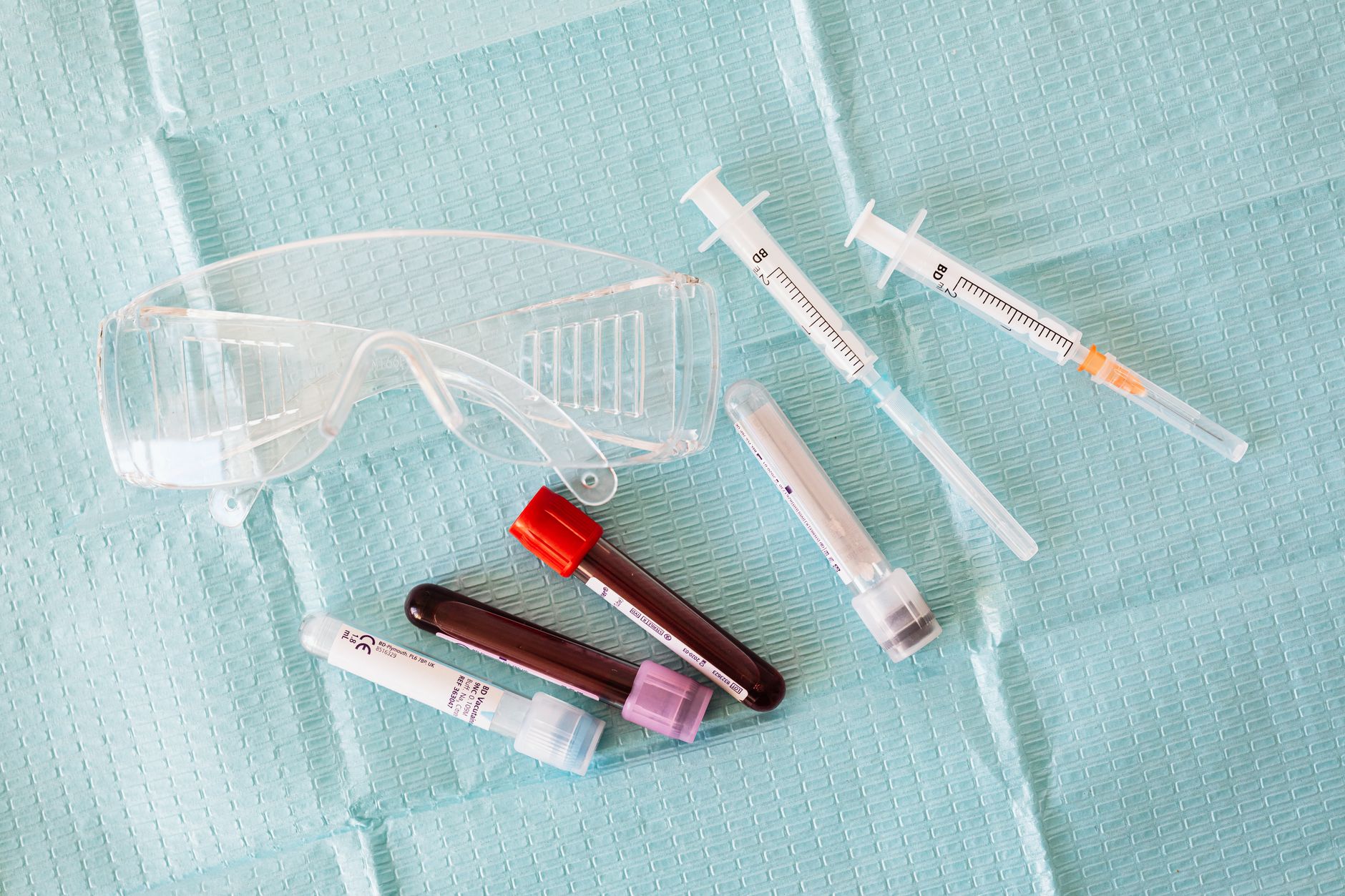
- Reconstitution means dissolving a lyophilized (freeze-dried) peptide powder in a sterile diluent, most often bacteriostatic water containing 0.9% benzyl alcohol.
- The volume of diluent you add does not change the total amount of peptide in the vial — it only changes the concentration, which in turn sets your draw volume.
- The core formula is: draw volume (mL) = desired dose (mg) ÷ concentration (mg/mL), where concentration = total peptide (mg) ÷ diluent added (mL).
- Add diluent slowly down the vial wall, never directly onto the powder, and swirl gently — never shake — to avoid shearing fragile peptide chains.
- Reconstituted peptides are generally stored refrigerated at 2–8 °C and used within a few weeks; lyophilized powder stored frozen and protected from light lasts far longer.
- This content is for educational purposes only. Most research peptides are not FDA/EMA approved for human use — consult a qualified healthcare professional.
What Is Peptide Reconstitution?
Peptide reconstitution is the process of dissolving a dry, freeze-dried peptide back into a liquid so it can be measured and used in research. Most research peptides — including popular compounds like BPC-157, TB-500, and GHK-Cu — are shipped as a white lyophilized (freeze-dried) powder inside a sealed glass vial. In this dry state the peptide is chemically stable and easy to transport, but it cannot be accurately dosed until it is turned back into a solution.
Lyophilization removes water under vacuum at low temperature, leaving behind a fragile cake or film of pure peptide. Because peptides are chains of amino acids held together by peptide bonds, they are sensitive to heat, agitation, and contamination. Reconstitution is therefore not simply "adding water" — it is a controlled procedure designed to dissolve the compound gently while keeping it sterile and biologically intact.
The single most important concept to understand before you begin is this: the amount of peptide in the vial is fixed. If your vial contains 5 mg of peptide, it will always contain 5 mg no matter how much liquid you add. What you control by choosing your diluent volume is the concentration — how much peptide sits in each milliliter of finished solution. Concentration is what determines how much liquid you draw for a given dose.
Getting reconstitution right matters because errors compound. An incorrect diluent volume, a contaminated vial, or improper storage can render an entire vial unusable or produce doses that are off by a factor of ten. If you are new to the underlying chemistry, our primer on what peptides are provides useful background before you handle any material.
This article is for educational purposes only and does not constitute medical advice. Most research peptides are classified "for research use only" and are not approved for human use. Always consult a qualified healthcare professional.
Which Diluent Should You Use?
The choice of diluent — the liquid you dissolve the powder in — depends on the peptide's solubility and how long you intend to keep the solution. The most widely used diluent for multi-use research vials is bacteriostatic water: sterile water containing 0.9% benzyl alcohol (C₇H₈O, molecular weight 108.14 g/mol). The benzyl alcohol acts as a preservative that inhibits bacterial growth, which is why bacteriostatic water is preferred whenever a vial will be accessed more than once over several days or weeks.
Sterile water for injection contains no preservative. It is suitable for single-use scenarios but offers no protection against microbial contamination once the vial is opened, so it is a poor choice for a vial you plan to use repeatedly. Bacteriostatic sodium chloride (0.9%) is another option, though the benzyl alcohol version is more common in peptide work.
A minority of peptides are poorly soluble in plain water and may require a small amount of a co-solvent to enter solution. Mildly acidic solutions such as dilute acetic acid are sometimes used for peptides that resist dissolving, while a few require a very small volume of sodium hydroxide or a similar agent. These situations are the exception, not the rule — always follow the specific solubility guidance provided with your compound rather than assuming water will work for everything.
The table below summarizes the common diluents and their typical use:
| Diluent | Preservative | Best for |
|---|---|---|
| Bacteriostatic water | 0.9% benzyl alcohol | Multi-use vials, extended storage |
| Sterile water for injection | None | Single-use, immediate use |
| Bacteriostatic 0.9% NaCl | Benzyl alcohol | Multi-use, isotonic preference |
| Dilute acetic acid | None | Poorly soluble peptides only |
A practical caution: benzyl alcohol is not recommended in very high cumulative volumes and is contraindicated in certain populations in a clinical context. This is one more reason these decisions belong with a healthcare professional and outside the scope of DIY use.
What Supplies Do You Need?
Reconstitution is a small procedure, but doing it cleanly requires the right equipment. Assembling everything before you open a vial reduces the time the peptide is exposed and lowers contamination risk. The essentials are inexpensive and widely available in research and laboratory supply channels.
At minimum you will need: your lyophilized peptide vial, a vial of bacteriostatic water, alcohol prep pads (isopropyl alcohol swabs), a reconstitution syringe with a needle for transferring the diluent, and a clean, flat work surface. Many researchers also use insulin-style syringes marked in units for accurate small-volume measurement.
Precision matters at small volumes, so the syringe markings you rely on are important. A standard 1 mL insulin syringe is graduated in 100 units, meaning each unit equals 0.01 mL. Because peptide doses are frequently drawn in tiny volumes, being able to read to the nearest unit or half-unit is what makes accurate dosing possible. Trying to measure 0.05 mL on a coarsely graduated syringe invites error.
- Alcohol swabs — clean the rubber stopper of both vials before every puncture.
- Reconstitution syringe — a larger syringe (1–3 mL) for drawing and adding diluent.
- Dosing syringe — a fine insulin syringe (units) for accurate draws.
- A reconstitution calculator — removes arithmetic error; our free Peptide Lab calculator handles the math for you.
- Storage — a refrigerator and, ideally, a light-protected container.
If you plan to run a structured protocol over weeks, keeping records of your reconstitution dates and concentrations is worthwhile. A dedicated log such as the Peptide Tracker helps you avoid using a vial past its practical shelf life and keeps your calculations consistent across refills.
How Do You Reconstitute a Peptide Step by Step?
The technique itself is straightforward once you understand the principles. The goal at every step is to dissolve the powder gently while keeping both the vial contents and the diluent sterile. Work slowly; there is no benefit to rushing, and haste is where most contamination and mechanical damage occur.
Step 1 — Prepare. Wash your hands and clean your work surface. Allow both vials to reach room temperature if they were refrigerated — cold glass can promote condensation. Remove the plastic caps and wipe the rubber stopper of each vial with a fresh alcohol swab, then let them dry for a few seconds.
Step 2 — Draw the diluent. Using your reconstitution syringe, draw the exact volume of bacteriostatic water you calculated (see the dosage-math section below). Insert the needle through the cleaned stopper of the water vial, invert, and pull the plunger to your target volume, expelling any air bubbles.
Step 3 — Add the diluent slowly. Insert the needle into the peptide vial and angle it so the water runs down the inside glass wall — never squirt it directly onto the powder. A hard stream can shear the delicate peptide and cause foaming. Let the water trickle in gently.
Step 4 — Dissolve gently. Once all the diluent is added, do not shake. Swirl the vial slowly or roll it between your palms, or simply set it down and let the peptide dissolve on its own over a few minutes. Most peptides go into solution readily. The finished liquid should be clear and colorless; cloudiness, particles, or persistent floating material can indicate incomplete dissolution, degradation, or contamination, and such a vial should not be used.
Step 5 — Store immediately. Label the vial with the date and concentration, then place it in the refrigerator. From here you draw individual doses with your fine insulin syringe as needed. Never shaking, always swirling, and always adding water to the wall rather than the powder are the three habits that most protect peptide integrity.
How Do You Calculate the Dose and Draw Volume?
The math behind reconstitution intimidates newcomers, but it rests on two simple relationships. Once you internalize them, every calculation becomes mechanical. Everything flows from the fact that the total peptide mass in the vial is fixed and only the concentration changes with diluent volume.
Relationship 1 — Concentration. The concentration of your finished solution is the total peptide divided by the diluent you added:
Concentration (mg/mL) = Total peptide (mg) ÷ Diluent added (mL)
Relationship 2 — Draw volume. The volume you draw for a single dose is the desired dose divided by that concentration:
Draw volume (mL) = Desired dose (mg) ÷ Concentration (mg/mL)
Two unit conversions trip people up. First, doses are often quoted in micrograms (mcg) while vials are labeled in milligrams (mg): 1 mg = 1,000 mcg. Second, insulin syringes read in units, where 100 units = 1 mL, so units = draw volume in mL × 100. Converting the final draw volume into units is what lets you read the dose off the syringe accurately.
A powerful practical takeaway is that you can choose your concentration by choosing your diluent volume. Adding more water to the same vial makes each dose a larger, easier-to-measure liquid volume; adding less water concentrates the peptide into smaller draws. Many researchers pick a diluent volume specifically so that a common dose lands on a round, easy-to-read number of units. To eliminate arithmetic mistakes entirely, run your numbers through the Peptide Lab reconstitution calculator and confirm them by hand.
If you are planning combinations of compounds — for example running two peptides on the same schedule — the calculations must be done independently for each vial, and you should also review the practical considerations in our peptide stacking guide before combining anything.
What Do Real Reconstitution Calculations Look Like?
Abstract formulas make more sense with concrete numbers. The following worked examples walk through the full path from vial to syringe. Follow the units carefully — that is where nearly all errors hide.
Example 1 — A 5 mg vial, 2 mL of water, 250 mcg dose. First find the concentration: 5 mg ÷ 2 mL = 2.5 mg/mL. Convert the dose to milligrams: 250 mcg = 0.25 mg. Now the draw volume: 0.25 mg ÷ 2.5 mg/mL = 0.1 mL. In insulin units that is 0.1 × 100 = 10 units. So each 250 mcg dose is 10 units on the syringe, and the vial holds twenty such doses.
Example 2 — A 10 mg vial, 2 mL of water, 500 mcg dose. Concentration: 10 mg ÷ 2 mL = 5 mg/mL. Dose in mg: 500 mcg = 0.5 mg. Draw volume: 0.5 ÷ 5 = 0.1 mL = 10 units. Notice that doubling both the vial size and the dose relative to Example 1 keeps the syringe reading identical — a reminder that concentration, not vial size alone, drives the draw.
Example 3 — Choosing water to hit a round number. Suppose you have a 5 mg vial and want a 500 mcg (0.5 mg) dose to read as exactly 25 units (0.25 mL). Work backwards: you need concentration = dose ÷ draw volume = 0.5 mg ÷ 0.25 mL = 2 mg/mL. To get 2 mg/mL from 5 mg, add 5 ÷ 2 = 2.5 mL of bacteriostatic water. This is the reverse-engineering trick many researchers use to make dosing effortless to read.
The table below shows how one 5 mg vial behaves at different diluent volumes for a fixed 250 mcg (0.25 mg) dose:
| Water added | Concentration | Draw for 250 mcg | Units |
|---|---|---|---|
| 1 mL | 5 mg/mL | 0.05 mL | 5 units |
| 2 mL | 2.5 mg/mL | 0.10 mL | 10 units |
| 3 mL | 1.67 mg/mL | 0.15 mL | 15 units |
| 5 mL | 1 mg/mL | 0.25 mL | 25 units |
Larger draw volumes are easier to measure precisely, which is why many people favor more diluent — the trade-off is that a heavily diluted vial holds a larger total liquid volume that must be stored and used within the solution's stability window.
How Should Reconstituted Peptides Be Stored?
Storage is where a correctly reconstituted vial is either preserved or quietly ruined. Peptides in solution are far less stable than in their dry, lyophilized form, so how and where you keep the vial directly determines how long the material remains intact. The two enemies are heat and time; light and repeated temperature swings accelerate the damage.
Lyophilized (dry) powder is the most stable form. Kept frozen — typically at −20 °C or colder — and protected from light and moisture, unopened peptide powder can remain viable for many months to a couple of years, depending on the specific compound and manufacturer guidance. Because peptide half-life in solution is limited, keeping material dry until you need it is the single best preservation strategy.
Reconstituted (liquid) peptide should be refrigerated at 2–8 °C. Do not freeze a reconstituted vial repeatedly: freeze-thaw cycles form ice crystals that mechanically damage peptide chains and degrade potency. As a general working rule, many reconstituted research peptides are used within roughly two to four weeks when refrigerated, though this varies by compound and by whether a bacteriostatic preservative was used. Always defer to the specific stability data for your peptide.
A few practical storage habits protect potency: keep the vial in the main body of the refrigerator rather than the door, where temperature fluctuates; store it upright in a light-blocking box or wrapped in foil; and never leave it at room temperature longer than necessary during dosing. Label every vial with its reconstitution date so you are never guessing how old a solution is.
Signs a solution has degraded include cloudiness, discoloration, visible particulates, or the appearance of a floating film. A degraded vial should be discarded rather than used. Because storage requirements differ meaningfully between compounds, review the individual monograph — for example the CJC-1295 guide — for peptide-specific handling notes before committing to a long protocol.
What Are the Most Common Reconstitution Mistakes?
Most reconstitution failures come from a short list of avoidable errors. Knowing them in advance is the fastest way to protect both your material and the accuracy of your dosing. Each of the following is common among newcomers and entirely preventable.
Shaking instead of swirling. Vigorous shaking creates foam and shear forces that can fragment peptide chains. Always dissolve by gentle swirling or by letting the vial sit. If foaming occurs, wait for it to settle before drawing.
Squirting water onto the powder. A hard jet of diluent aimed straight at the peptide cake damages it and can cause it to clump. Direct the stream down the glass wall so it flows in gently, as described in the step-by-step section above.
Getting the units wrong. Confusing micrograms with milligrams, or misreading insulin units, produces dosing errors of 10× or more. Double-check every conversion: 1 mg = 1,000 mcg, and 100 units = 1 mL. Verifying your numbers with the Peptide Lab calculator alongside a manual check catches these before they matter.
Skipping sterile technique. Failing to swab stoppers, touching needle tips, or reusing needles introduces contamination that a bacteriostatic preservative cannot fully counter. Treat every puncture as a sterility-critical step.
- Using the wrong diluent — plain sterile water in a multi-use vial invites contamination; use bacteriostatic water for repeated access.
- Freezing reconstituted solution — freeze-thaw cycles destroy potency; refrigerate instead.
- Ignoring visual cues — cloudiness or particles mean discard, not use.
- Forgetting to label — an undated vial is a guessing game; always record the reconstitution date and concentration.
Finally, the most important reminder of all is a regulatory and safety one: the peptides discussed here are, in most jurisdictions, classified for research use only and are not approved for human use by the FDA or EMA. Legal status varies by country. Nothing in this guide is medical advice. Before handling or using any peptide, consult a qualified healthcare professional and review our medical disclaimer.
Recommended products
Research peptides selected for quality and purity:
GHK-Cu
Anti-Aging Compound
Test your knowledge
Quick quiz · 6 questions
Peptide Lab — free calculator & tracker
Calculate your reconstitution, track your peptides and injections. Free, no credit card required.
Frequently Asked Questions
How much bacteriostatic water should I add to a peptide vial?
Can I use tap water or regular bottled water to reconstitute peptides?
How long does a reconstituted peptide last?
Why shouldn't I shake the vial to dissolve the peptide faster?
How do I convert my dose into insulin syringe units?
Sources
- U.S. Food and Drug Administration (2024). Inactive Ingredient Database: Benzyl Alcohol as a Bacteriostatic Preservative. FDA.gov Guidance.
- Manning MC, Chou DK, Murphy BM, et al. (2010). Stability of Protein Pharmaceuticals: An Update. Pharmaceutical Research.
- Wang W. (2000). Lyophilization and Development of Solid Protein Pharmaceuticals. International Journal of Pharmaceutics.
- Frokjaer S, Otzen DE. (2005). Protein Drug Stability: A Formulation Challenge. Nature Reviews Drug Discovery.
- Wang W, Nema S, Teagarden D. (2010). Protein Aggregation — Pathways and Influencing Factors. International Journal of Pharmaceutics.
- LeBel M, et al. (2019). Benzyl Alcohol Safety and Use as a Preservative in Injectable Formulations. Annals of Pharmacotherapy.