

Prices and stock are set by each vendor and can change. Always confirm third-party testing on the vendor site.
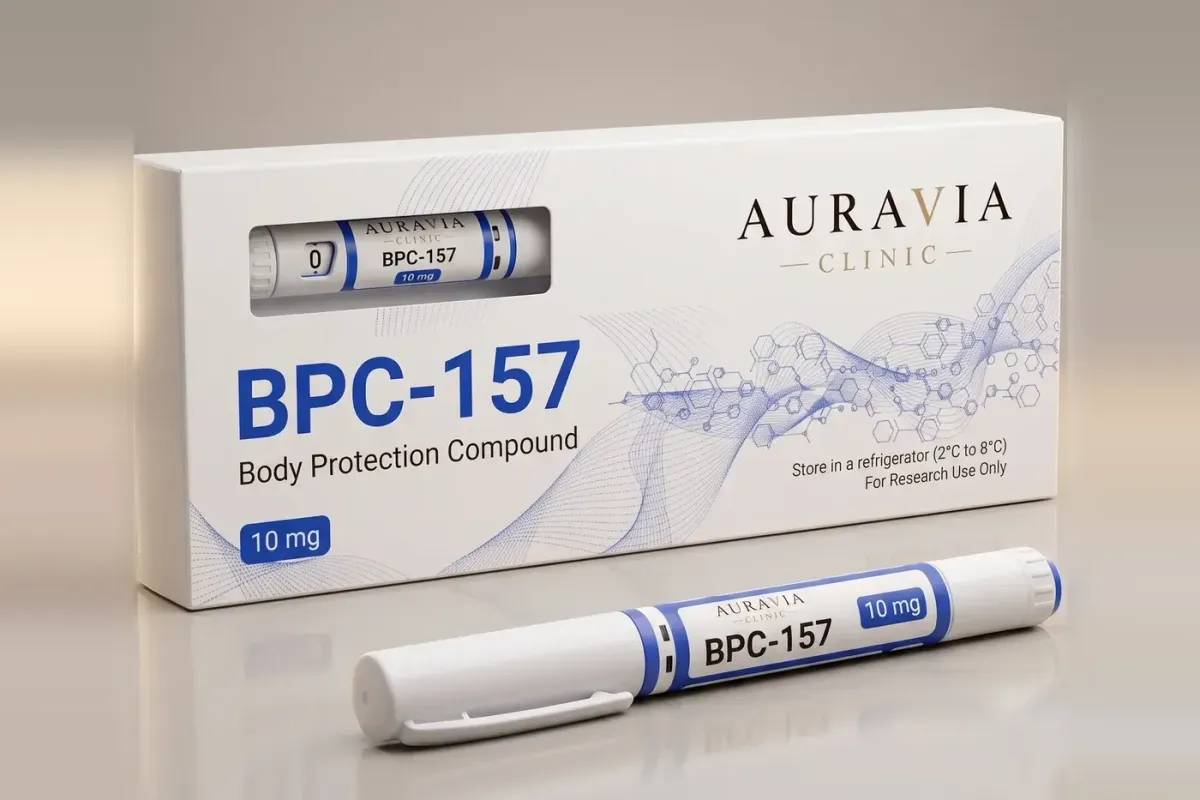
- The BPC-157 pen holds 10 mg of BPC-157 already in solution (3 ml) in a sealed cartridge: there is nothing to reconstitute.
- On October 19, 2026, the pen costs €69.99 (list price €79.99) versus €39.99 for the 10 mg vial: €7.00 per mg versus €4.00 per mg.
- A peptide in solution is less stable than a freeze-dried powder: the pen must stay between 2 and 8 °C, from shipping to storage.
- In our checks, only AuraVia Research sells a BPC-157 pen today, from an EU warehouse, with a certificate of analysis per batch (HPLC purity 99.7%).
- BPC-157 is a research peptide studied mostly in animal models. It is not an approved medicine, and this page gives no usage advice.
What is the BPC-157 pen?
The BPC-157 pen is a pre-filled pen: the peptide is already dissolved and sealed in a cartridge inside a plastic body, on the model of insulin pens. The version sold by AuraVia Research holds 10 mg of BPC-157 in 3 ml of solution. A graduated dial at the end of the pen sets the volume that the mechanism releases. Unlike a vial, there is no powder to reconstitute and no solvent to handle.
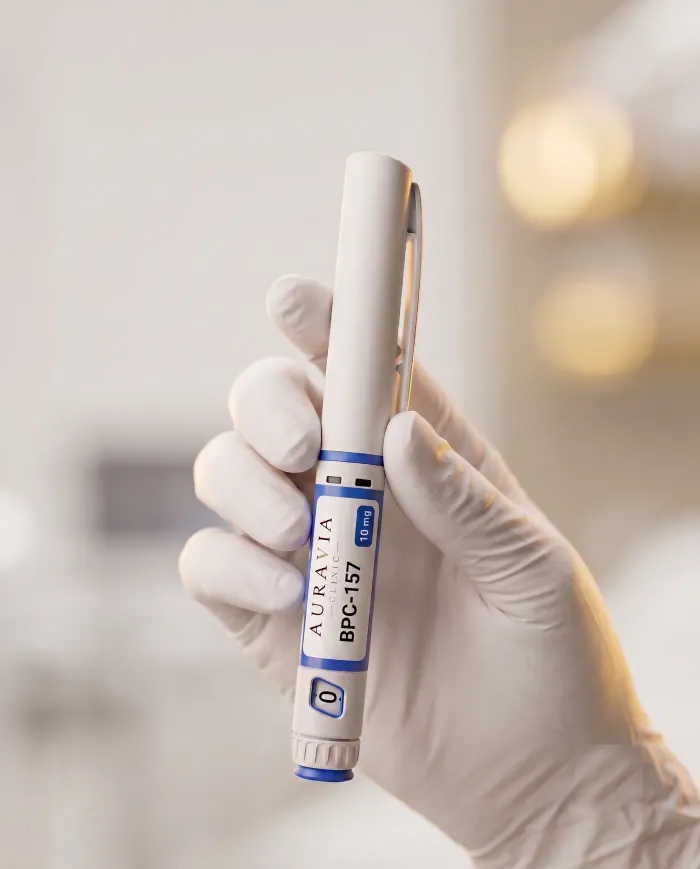
The vendor states the following characteristics for this product:
| Characteristic | BPC-157 Pen |
|---|---|
| Content | 10 mg of BPC-157 |
| Volume | 3 ml of solution |
| Format | Pre-filled pen, sealed cartridge, graduated dial |
| Storage | Refrigerated, 2 to 8 °C |
| Purity (HPLC) | 99.7% (batch AVC-2609-0720) |
| Documents | Certificate of analysis with every order |
BPC-157 itself is a pentadecapeptide: a chain of 15 amino acids derived from a protein found in gastric juice. The pen does not change the molecule. It only changes the form in which it is stored and sold: a ready-made solution instead of a freeze-dried powder. That choice has consequences for price and stability, covered in the next section.
The same vendor sells other pens built on the same format, including a TB-500 pen. Like them, the BPC-157 pen is a research product, not a medicine.
Pen or vial for BPC-157?
AuraVia Research sells BPC-157 in both formats, with the same amount (10 mg) and the same stated purity (99.7%). The comparison is therefore direct. Prices checked on October 19, 2026, VAT included:
| Format | Amount | List price | Price on 19/10/2026 | Price per mg |
|---|---|---|---|---|
| Pre-filled pen (solution) | 10 mg in 3 ml | €79.99 | €69.99 (promotion) | €7.00 |
| Vial (freeze-dried powder) | 10 mg | €49.99 | €39.99 | €4.00 |
At current prices, the pen costs 75% more than the vial for the same amount of BPC-157 (60% more at list prices). The difference pays for the cartridge, the dial mechanism and refrigerated handling. Prices change, and the pen is on promotion at the time of writing: check the current price on the vendor's site before you order.
Stability is the other difference. Reference reviews on protein pharmaceuticals show that in solution, these molecules undergo more degradation reactions (oxidation, aggregation, hydrolysis) than in the dry state (Wang, 1999). This is why the industry freeze-dries fragile proteins for storage (Wang, 2000). These reviews deal with proteins in general, not with BPC-157 specifically, but the principle applies to any peptide kept in solution.
What each format implies in practice:
- Vial: a freeze-dried powder that has to be reconstituted before any experiment, with a solvent sold separately. Until then, it keeps better, stored cool, dry and away from light.
- Pen: nothing to prepare, but the product is already in solution. It needs an unbroken cold chain (2 to 8 °C) from the warehouse to storage, and a solution generally keeps for less time than a powder.
For the same comparison across all compounds sold as pens (TB-500, GHK-Cu, NAD+ and others), see our pre-filled peptide pen vs vial comparison.
Where to buy the BPC-157 pen
Today, in our checks, only one vendor sells a pre-filled BPC-157 pen: AuraVia Research, which ships within the European Union. Our checks cover the vendors we follow, so this may change if new offers appear.
| Criterion | AuraVia Research |
|---|---|
| Warehouse | European Union |
| VAT | Included in the price |
| Shipping | Standard tracked, 3 to 5 working days |
| Shipping cost | €9, free from €150 |
| Delivery area | European Union only |
| Quality documents | Certificate of analysis per batch, purity measured by HPLC |
| Label | Batch number printed on the label |
Shipping from inside the EU means no customs fees for buyers in the Union. On the other hand, the vendor does not deliver outside the EU. If you live outside the EU, or if you prefer the powder format, you can compare vial vendors on our page where to buy BPC-157.
Transparency: the AuraVia Research links on this page are affiliate links. If you order through them, Klow Peptide may receive a commission at no extra cost to you. It does not change the facts reported here.
What does research say about BPC-157?
BPC-157 (Body Protection Compound-157) is a synthetic pentadecapeptide of 15 amino acids, derived from a protein present in human gastric juice. A Croatian research team first described it in the 1990s. Most of the literature comes from that group, and the data come mainly from in vivo studies in rats and mice, along with cell-culture experiments.
The most studied areas are the gastrointestinal tract and soft tissues. In rats, studies have looked at tendon-to-bone healing after Achilles tendon detachment (Krivic et al., 2006) and at the vascular response after ligation of the inferior caval vein (Vukojević et al., 2018). In vitro, tendon fibroblasts exposed to BPC-157 showed more outgrowth, survival and migration (Chang et al., 2011). A review by the original team summarises the work on the gastrointestinal tract and on vascular recruitment (Sikiric et al., 2018).
These are preclinical results. No large randomised clinical trial in humans has been published, and human pharmacokinetic and safety data remain very limited. BPC-157 is not an approved medicine: neither the EMA in Europe nor the FDA in the United States has authorised it. For the mechanisms studied, the full list of studies and their limits, see our BPC-157 guide.
How to check a BPC-157 pen before you buy
You check a pen the same way as a vial, plus a few points that come from the solution form.
- Batch and certificate of analysis: the batch number on the CoA must match the one printed on the pen label or on the box.
- Purity measured by HPLC: the CoA should state the method, the result and the date of the analysis. For this pen, the vendor reports 99.7% for batch AVC-2609-0720.
- Cold-chain shipping: a solution should travel refrigerated or in insulated packaging. Ask the vendor how the pen is shipped and check its condition on arrival.
- Complete label: content (10 mg), volume (3 ml), batch number and expiry date must appear on the pen or on its packaging.
- Sealed cartridge: the cartridge and the pen must arrive intact and sealed, with no sign of opening or leakage.
- “Research use only” statement: a serious vendor does not present its pen as a medicine and makes no health claim.
A price far below the market should make you careful. A pen requires a cartridge, a mechanism and cold handling, so it necessarily costs more to produce than a vial.
What is the legal status of the BPC-157 pen?
The BPC-157 pen has the same status as the BPC-157 vial. In the European Union, it is sold for laboratory research only. It has no marketing authorisation as a medicine, and the vendor states that it is not intended for human use. The pen format looks like the pens used for approved medicines, but it does not change this status.
Rules on buying, importing and possessing research peptides differ from one country to another, including within the EU. Check the rules that apply where you live before you order. This page is for information only: it gives no medical advice and no instructions for use.
Recommended products
Research peptides selected for quality and purity:
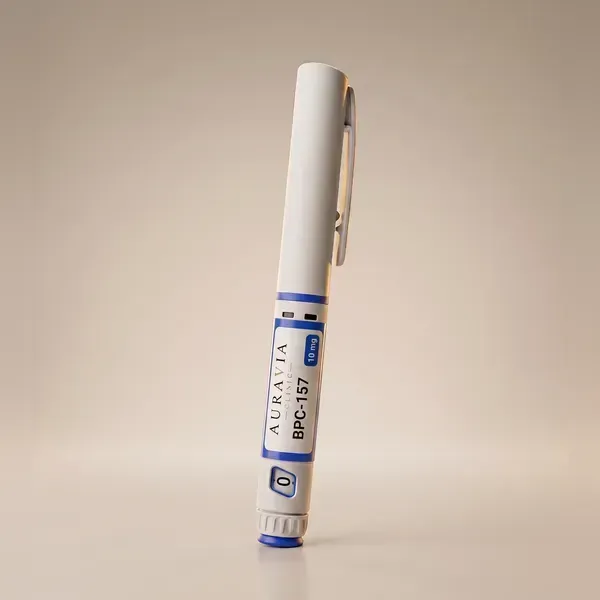
BPC-157 Pen
Pre-filled Pen BPC-157

BPC-157
Healing Peptide
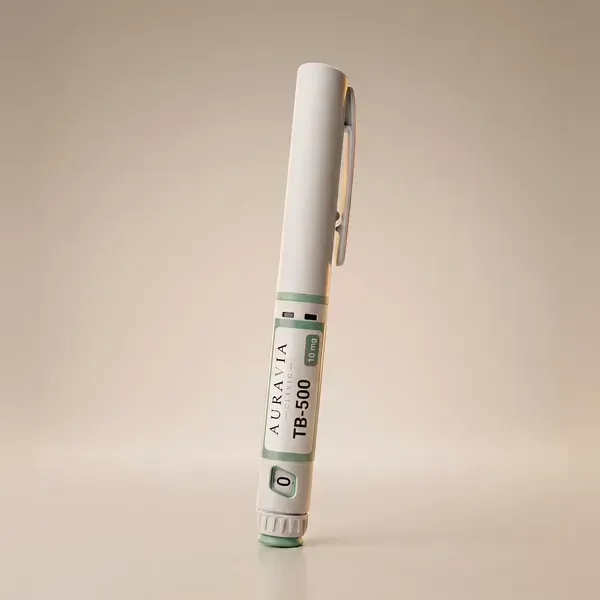
TB-500 Pen
Pre-filled Pen TB-500
Test your knowledge
Quick quiz · 6 questions
Peptide Lab: free calculator & tracker
Calculate your reconstitution, track your peptides and injections. Free, no credit card required.
Frequently Asked Questions
What is the difference between the BPC-157 pen and the BPC-157 vial?
How much does the BPC-157 pen cost?
How is the BPC-157 pen stored?
Can the BPC-157 pen be shipped outside the EU?
Is BPC-157 an approved medicine?
What documents come with the BPC-157 pen?
Sources
- Krivic A, Anic T, Seiwerth S, Huljev D, Sikiric P. (2006). Achilles detachment in rat and stable gastric pentadecapeptide BPC 157: Promoted tendon-to-bone healing and opposed corticosteroid aggravation. J Orthop Res, 24(5), 982-989. (PubMed)
- Chang CH, Tsai WC, Lin MS, Hsu YH, Pang JH. (2011). The promoting effect of pentadecapeptide BPC 157 on tendon healing involves tendon outgrowth, cell survival, and cell migration. J Appl Physiol, 110(3), 774-780. (PubMed)
- Vukojević J, Siroglavić M, Kašnik K, et al. (2018). Rat inferior caval vein (ICV) ligature and particular new insights with the stable gastric pentadecapeptide BPC 157. Vascul Pharmacol, 106, 54-66. (PubMed)
- Sikiric P, Rucman R, Turkovic B, et al. (2018). Novel Cytoprotective Mediator, Stable Gastric Pentadecapeptide BPC 157. Vascular Recruitment and Gastrointestinal Tract Healing. Curr Pharm Des, 24(18), 1990-2001. (PubMed)
- Wang W. (1999). Instability, stabilization, and formulation of liquid protein pharmaceuticals. Int J Pharm, 185(2), 129-188. (PubMed)
- Wang W. (2000). Lyophilization and development of solid protein pharmaceuticals. Int J Pharm, 203(1-2), 1-60. (PubMed)