
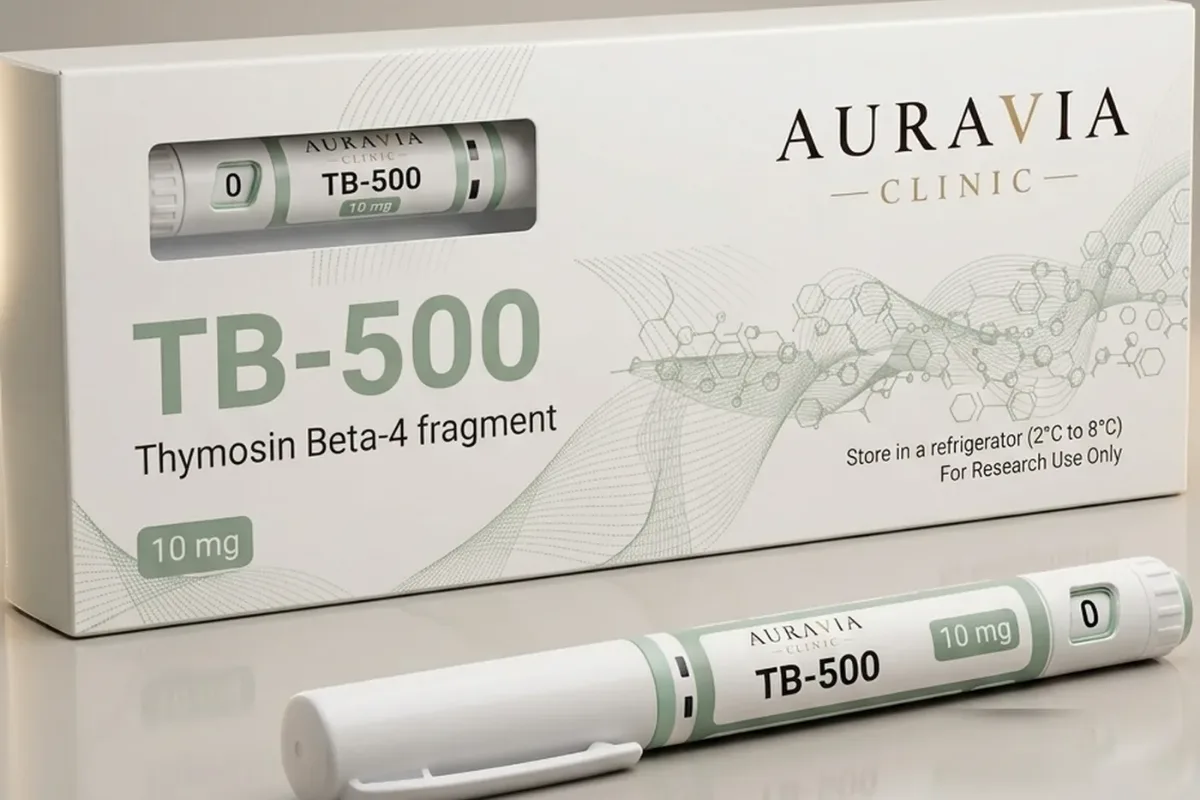
- A pre-filled peptide pen holds the peptide already in solution, in a sealed cartridge, on the model of insulin pens.
- A vial most often holds a lyophilized (freeze-dried) powder, which is more stable than a solution.
- For the same amount, the pen costs 43% (TB-500) to 125% (NAD+) more than the vial at AuraVia Research.
- AuraVia Research sells 7 pens in Europe (BPC-157, GHK-Cu, Glow, MOTS-c, NAD+, retatrutide, TB-500), shipped from the EU, VAT included.
- These pens are research products, not approved medicines: this article gives no dosage.
What is a pre-filled peptide pen?
A pre-filled peptide pen is an injector pen whose cartridge already holds the peptide in solution. The design comes from insulin pens, which diabetes care has used for decades (Pearson, 2010): a plastic body, a sealed cartridge, a cap and a graduated mechanism. A few research-peptide vendors have adopted the format, such as AuraVia Research in Europe.
The difference from the classic format lies in the state of the product. A research-peptide vial usually holds a lyophilized powder, meaning freeze-dried. The pen holds a ready-made solution. The compound is the same, but it is not stored in the same form, and that choice affects price, stability and quality control.
One thing does not change: these pens are sold as research products. They are not approved medicines, even if they look like Ozempic or Wegovy pens. This article compares the two formats on factual criteria. It gives no dosage and no usage advice.
Vial or pen: what are the differences?
The table below sums up the differences between the two formats, based on the product pages published by AuraVia Research and on the literature on protein stability.
| Criterion | Vial | Pre-filled pen |
|---|---|---|
| Product form | Lyophilized powder | Ready-made solution in a cartridge |
| Preparation before an experiment | Has to be put into solution | None |
| Stated storage | Cool, dry and away from light | Refrigerator (2 to 8 °C) |
| Stability | Higher in the dry state | More sensitive: a solution degrades faster |
| Price for the same amount | Baseline | 43% to 125% more expensive (see below) |
| Certificate of analysis | Per batch | Per batch |
Stability is the main technical point. Reference reviews on therapeutic proteins show that in solution these molecules undergo more degradation reactions (oxidation, aggregation, hydrolysis) than in the dry state (Wang, 1999; Manning et al., 2010). This is why the industry lyophilizes fragile proteins (Wang, 2000). A pre-filled pen therefore needs an unbroken cold chain, from shipping to storage.
The pen has one practical advantage: there is no powder and no solvent to handle. That is the main reason for its popularity. This convenience has a cost, which the next section puts into numbers.
How much does a pen cost compared with a vial?
To compare the two formats, look at the price for the same amount of active compound. At AuraVia Research, which sells both formats for the same compounds, the pen costs between 43% and 125% more than the vial. Prices checked on October 13, 2026, VAT included.
| Compound | Amount | Vial | Pen | Difference |
|---|---|---|---|---|
| BPC-157 | 10 mg | €39.99 | €79.99 | +100% |
| GHK-Cu | 50 mg | €59.99 | €89.99 | +50% |
| Glow (BPC-157 + TB-500 + GHK-Cu) | 70 mg | €109.99 | €169.99 | +55% |
| MOTS-c | 10 mg | €59.99 | €89.99 | +50% |
| NAD+ | 500 mg | €79.99 | €179.99 | +125% |
| Retatrutide | 10 mg | €129.99 | €249.99 | +92% |
| TB-500 | 10 mg | €69.99 | €99.99 | +43% |
The gap is smallest for TB-500 and largest for NAD+. For retatrutide, the 20 mg pen costs €429.99 versus €229.99 for the 20 mg vial. These prices change: always check the current price on the vendor's site before you order.
AuraVia Research's 7 pre-filled pens
AuraVia Research ships from a warehouse in the European Union, VAT included, in 2 to 4 business days. Shipping costs €9 for France, Spain and Portugal, and is free on orders from €200. The vendor delivers within the European Union only. Each batch comes with a certificate of analysis, with purity measured by HPLC.
| Pen | Contents | Price | Purity (HPLC) |
|---|---|---|---|
 BPC-157 Pen BPC-157 Pen | 10 mg | €79.99 | 99.7% |
 GHK-Cu Pen GHK-Cu Pen | 50 mg | €89.99 | 99.6% |
 Glow Pen (BPC-157 + TB-500 + GHK-Cu) Glow Pen (BPC-157 + TB-500 + GHK-Cu) | 70 mg | €169.99 | 99.2% |
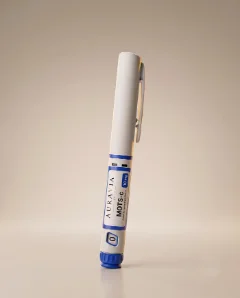 MOTS-c Pen MOTS-c Pen | 10 mg | €89.99 | 99.0% |
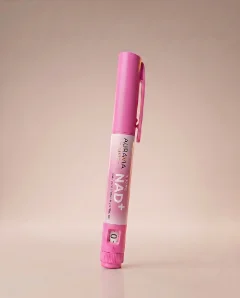 NAD+ Pen NAD+ Pen | 500 mg or 1000 mg | €179.99 or €299.99 | 99.3% |
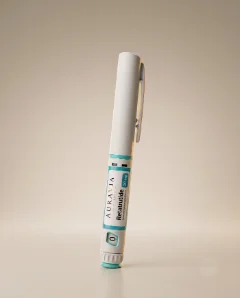 Retatrutide Pen Retatrutide Pen | 10 mg or 20 mg | €249.99 or €429.99 | 99% or higher |
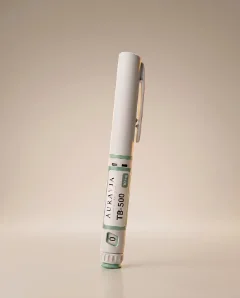 TB-500 Pen TB-500 Pen | 10 mg | €99.99 | 99.1% |
The Glow Pen is the only blend in the range: it combines BPC-157, TB-500 and GHK-Cu. It is therefore not a pure BPC-157 + TB-500 blend. To compare vendors for each compound, see our guides where to buy TB-500, where to buy NAD+ and where to buy a BPC-157 + TB-500 blend.
How to evaluate a peptide pen before buying
You check a pen the same way as a vial, with two extra points that come from the solution form.
- Certificate of analysis tied to the batch: the batch number on the CoA must match the one printed on the pen or on the box.
- Purity measured by HPLC: ideally above 98%, with the date of the analysis.
- Cold chain: a product in solution should travel in an insulated package. Ask the vendor how it ships.
- Expiry date: a solution keeps for less time than a powder. This date must appear on the packaging.
- “Research use only” statement: a serious vendor does not present its pen as a medicine.
- Delivery area and VAT: a vendor that ships from the EU spares European buyers customs fees.
An unusually low price should make you suspicious. A pen needs a cartridge, a mechanism and cold shipping: it necessarily costs more to produce than a vial.
What is the legal status of peptide pens?
Research peptide pens have the same status as vials: they are sold for laboratory research, with no marketing authorization as a medicine, neither from the EMA in Europe nor from the FDA in the United States. The pen format does not change this status.
Do not confuse them with pens for approved medicines, such as semaglutide (Ozempic, Wegovy) or tirzepatide (Mounjaro). Those are prescribed, made under pharmaceutical control and dispensed by pharmacies. Retatrutide, on the other hand, is still in clinical trials and is not approved anywhere. Rules on buying and importing vary from country to country: check them before you place any order.
Recommended products
Research peptides selected for quality and purity:
GHK-Cu
Anti-Aging Compound
Test your knowledge
Quick quiz · 6 questions
Peptide Lab: free calculator & tracker
Calculate your reconstitution, track your peptides and injections. Free, no credit card required.
Frequently Asked Questions
Is a pre-filled peptide pen more expensive than a vial?
Where can you buy a peptide pen in Europe?
Does a peptide pen keep less well than a vial?
What is the difference between a research peptide pen and an Ozempic pen?
Is the Glow Pen a BPC-157 + TB-500 blend?
How can you check the quality of a peptide pen?
Sources
- Pearson TL. (2010). Practical aspects of insulin pen devices. J Diabetes Sci Technol, 4(3), 522-531. (PubMed)
- Wang W. (1999). Instability, stabilization, and formulation of liquid protein pharmaceuticals. Int J Pharm, 185(2), 129-188. (PubMed)
- Wang W. (2000). Lyophilization and development of solid protein pharmaceuticals. Int J Pharm, 203(1-2), 1-60. (PubMed)
- Manning MC, Chou DK, Murphy BM, Payne RW, Katayama DS. (2010). Stability of protein pharmaceuticals: an update. Pharm Res, 27(4), 544-575. (PubMed)