

Prices and stock are set by each vendor and can change. Always confirm third-party testing on the vendor site.
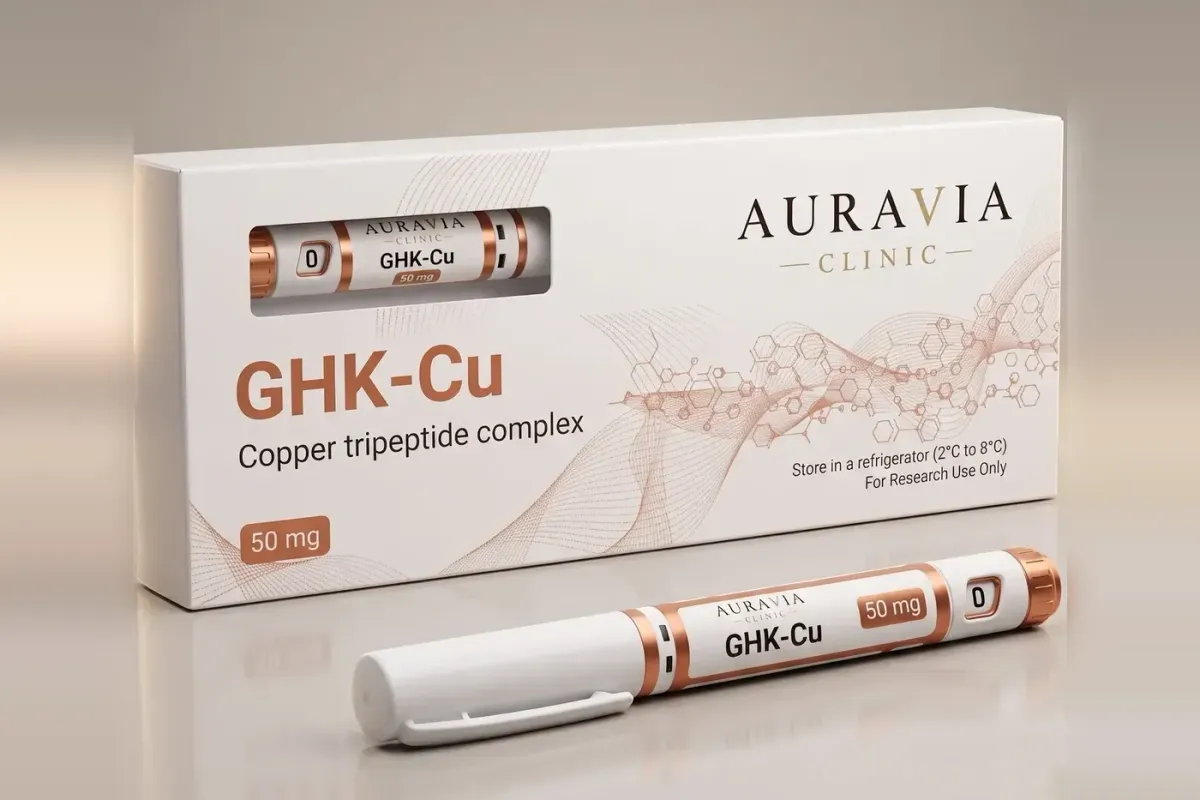
- The GHK-Cu pen is a pre-filled pen: the copper peptide is already in solution in a sealed cartridge, so there is no reconstitution step.
- The pen sold by AuraVia Research holds 50 mg, must be stored at 2 to 8 °C and is stated at 99.6% purity by HPLC, with a CoA for every order.
- On 19 October 2026 the pen cost €79.99 (list price €89.99), or €1.60 per mg, against €0.90 per mg for the 50 mg lyophilised vial.
- In our checks, AuraVia Research is the only vendor selling a GHK-Cu pen today, and it ships within the EU only.
- GHK-Cu is studied mainly in skin research and cosmetic formulations. The research pen is not a cosmetic and not an approved medicine: this page gives no usage advice.
What is the GHK-Cu pen?
The GHK-Cu pen is a pre-filled pen that holds GHK-Cu, the copper complex of the tripeptide glycyl-L-histidyl-L-lysine, already in solution. The peptide sits in a sealed cartridge inside a plastic body, on the model of insulin pens. A graduated dial mechanism sits at the end of the pen. Because the product is delivered as a solution, there is no powder to reconstitute and no solvent to handle.
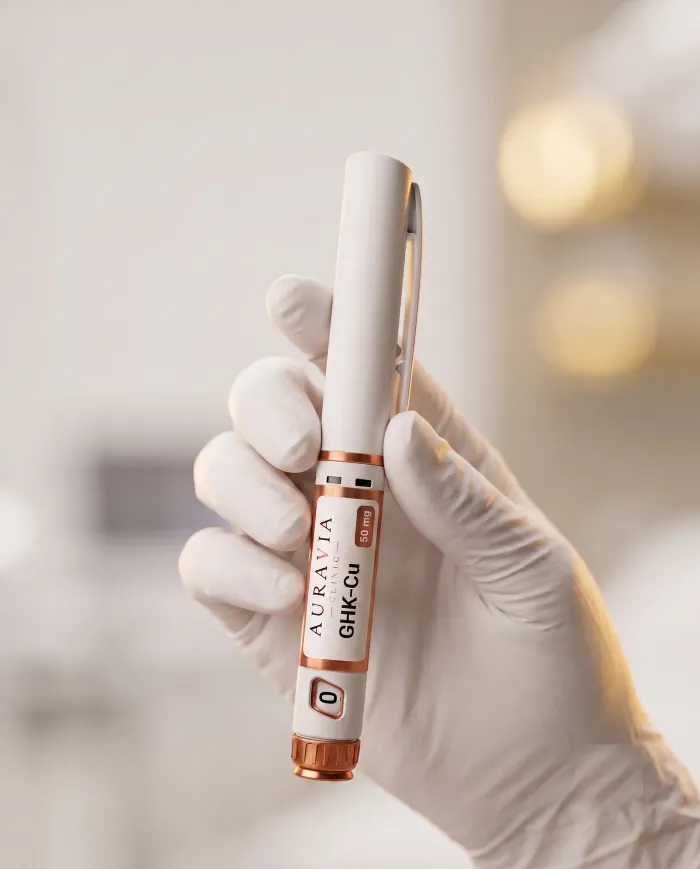
The model checked for this page is the GHK-Cu Pen from AuraVia Research. According to the product page consulted on 19 October 2026, it contains 50 mg of GHK-Cu, must be kept in the refrigerator between 2 and 8 °C, and is stated at 99.6% purity by HPLC. A certificate of analysis (CoA) comes with every order. The product page does not state the volume of solution in the cartridge, so we do not give one here.
Many readers know GHK-Cu from serums and creams. These cosmetic products are applied to the skin and sold under cosmetics rules. The pen is something else: a research product in solution, sold for laboratory use, and not a skincare product. Our article on injectable versus topical GHK-Cu explains the difference between the two contexts in more detail.
GHK-Cu pen or vial: price and stability
AuraVia Research sells GHK-Cu in two formats: the pre-filled pen and the classic vial of lyophilised (freeze-dried) powder. The fairest comparison is the price for the same amount of compound. The table below uses the prices shown on the vendor's site on 19 October 2026, VAT included.
| Format | Amount | List price | Price on 19/10/2026 | Price per mg |
|---|---|---|---|---|
| Pre-filled pen | 50 mg | €89.99 | €79.99 | €1.60 |
| Lyophilised vial | 50 mg | €59.99 | €44.99 | €0.90 |
| Lyophilised vial | 100 mg | €89.99 | €79.99 | €0.80 |
At current prices, the pen costs about 78% more than the 50 mg vial for the same amount. At list prices the gap is 50%. Another way to read the table: for €79.99 you get either 50 mg in a pen or 100 mg as powder in a vial. Both formats were on promotion on the day of our check. Prices change often, so always check the current price on the vendor's site before you order.
The second difference is stability. In solution, proteins and peptides are exposed to more degradation reactions (oxidation, aggregation, hydrolysis) than in the dry state (Wang, 1999). This is why the pharmaceutical industry freeze-dries fragile molecules (Wang, 2000). The product data we checked gives no shelf-life figure for this specific solution. The general rule still applies: a solution needs an unbroken cold chain, while a lyophilised powder tolerates storage conditions better.
In practice, each format implies a different workflow:
- Vial: the powder has to be put into solution before an experiment, with the material and care that this step requires. In return, the unopened vial is more stable and cheaper per mg.
- Pen: no reconstitution and no solvent, but a higher price per mg and a product that must stay between 2 and 8 °C from shipping to storage.
For a comparison of all the pens on the market and a wider look at the two formats, see our guide to the pre-filled peptide pen versus the vial.
Where to buy the GHK-Cu pen
Today, in our checks, only one vendor sells a pre-filled GHK-Cu pen: AuraVia Research, based in the European Union. The conditions published by the vendor are as follows:
- Warehouse: in the EU, prices VAT included.
- Shipping: standard tracked delivery in 3 to 5 working days, €9, free from €150.
- Delivery area: EU only.
- Quality: a certificate of analysis per batch, with purity measured by HPLC, and the batch number printed on the label.
AuraVia Research also sells a pen that contains GHK-Cu in a blend with BPC-157 and TB-500. If you are comparing the two, see our page on the Glow pen.
Readers outside the EU cannot order this pen. They can compare vendors that sell GHK-Cu as a vial on our page where to buy GHK-Cu, which lists shipping areas, CoA and HPLC tests for each vendor.
What research says about GHK-Cu
GHK is a tripeptide naturally present in human plasma, saliva and urine, with a strong affinity for copper (II) ions. It was described in 1973 by Loren Pickart. Its plasma level is reported to fall with age, which has drawn research toward skin ageing and tissue repair.
Most of the literature concerns the skin. A review by Pickart and colleagues sums up the cell studies and the topical formulations evaluated in cosmetic research, notably on collagen and the extracellular matrix (Pickart et al., 2015). Other work has looked at gene expression: a team identified a gene expression signature linked to emphysema in lung tissue, then tested GHK on cultured lung fibroblasts for its ability to reverse it (Campbell et al., 2012). In animal models, a tripeptide-copper complex was tested topically on ischemic open wounds in dogs (Canapp et al., 2003), and a biotinylated GHK incorporated into collagen matrices was studied in diabetic rats (Arul et al., 2007).
These results come mostly from cell cultures, animal models and topical cosmetic studies. They do not show what a GHK-Cu solution does in humans outside these contexts. GHK-Cu is not an approved medicine, neither in the EU nor in the United States. For the mechanism, the history and the full list of studies, read our complete GHK-Cu guide.
How to check a GHK-Cu pen before you buy
You check a pen the same way as a vial, with a few extra points that come from the solution form.
- Batch and CoA match: the batch number on the certificate of analysis must match the one printed on the pen or on the box.
- HPLC purity: the CoA should give the purity measured by HPLC and the date of the analysis. AuraVia Research states 99.6% for this pen.
- Cold-chain shipping: a product in solution should travel in insulated packaging. Ask the vendor how it ships if the information is not on the site.
- Complete label: content in mg, volume, batch number and expiry date. A solution keeps for less time than a powder, so the expiry date matters.
- Sealed cartridge: the cartridge must be intact on arrival, with no visible leak and no sign of opening.
- Research-use statement: a serious vendor does not present its pen as a medicine or as a skincare product.
A price far below the market should make you cautious. A pen needs a cartridge, a mechanism and cold shipping, so it costs more to produce than a vial.
What is the legal status of the GHK-Cu pen?
In the EU, the GHK-Cu pen is sold as a research product only. It has no marketing authorisation as a medicine, neither from the EMA nor from the FDA in the United States. The vendor states that the product is not intended for human use. The pen format does not change this status, even if the device looks like the pens of approved medicines.
Cosmetic products that contain GHK-Cu, such as serums, fall under a different legal framework. Rules on buying and importing research peptides vary from country to country: check the rules where you live before you order. This page gives no medical advice and no usage instructions.
Recommended products
Research peptides selected for quality and purity:
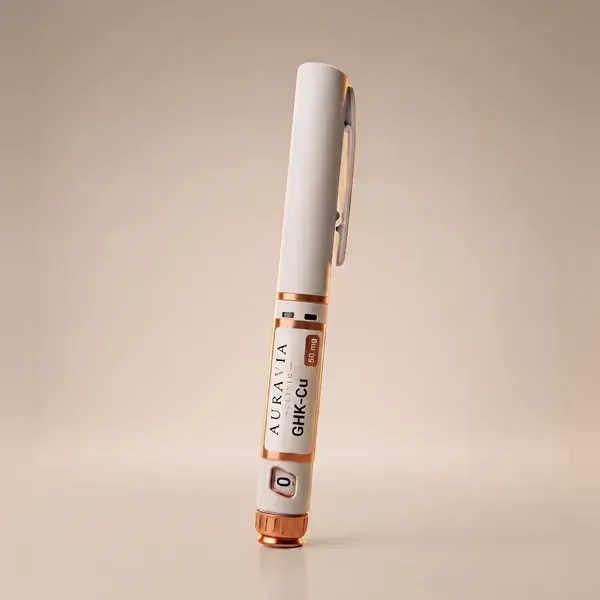
GHK-Cu Pen
Pre-filled Pen GHK-Cu

GHK-Cu
Anti-Aging Compound
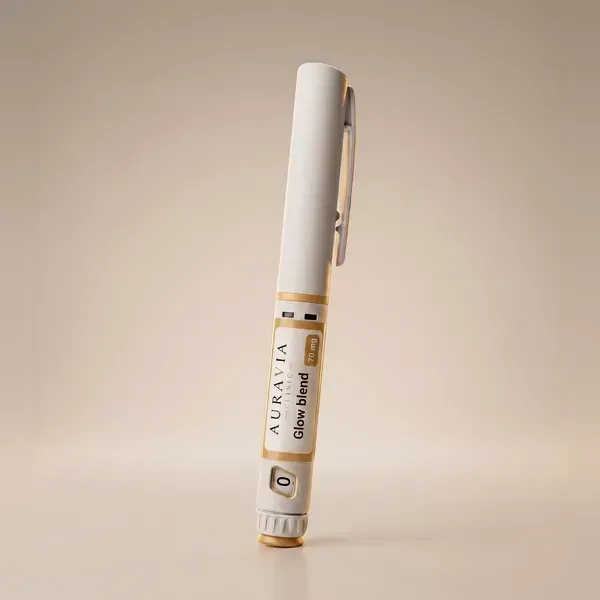
Glow Pen
Pre-filled Pen Glow
Test your knowledge
Quick quiz · 6 questions
Peptide Lab: free calculator & tracker
Calculate your reconstitution, track your peptides and injections. Free, no credit card required.
Frequently Asked Questions
What is the difference between the GHK-Cu pen and the GHK-Cu vial?
How much does a GHK-Cu pen cost?
How should a GHK-Cu pen be stored?
Can I buy the GHK-Cu pen outside the EU?
Is the GHK-Cu pen an approved medicine?
Is the GHK-Cu pen the same as a GHK-Cu serum?
Sources
- Pickart L, Vasquez-Soltero JM, Margolina A. (2015). GHK Peptide as a Natural Modulator of Multiple Cellular Pathways in Skin Regeneration. Biomed Res Int, 2015, 648108. (PubMed)
- Campbell JD, McDonough JE, Zeskind JE, et al. (2012). A gene expression signature of emphysema-related lung destruction and its reversal by the tripeptide GHK. Genome Med, 4(8), 67. (PubMed)
- Canapp SO Jr, Farese JP, Schultz GS, et al. (2003). The effect of topical tripeptide-copper complex on healing of ischemic open wounds. Vet Surg, 32(6), 515-523. (PubMed)
- Arul V, Kartha R, Jayakumar R. (2007). A therapeutic approach for diabetic wound healing using biotinylated GHK incorporated collagen matrices. Life Sci, 80(4), 275-284. (PubMed)
- Wang W. (1999). Instability, stabilization, and formulation of liquid protein pharmaceuticals. Int J Pharm, 185(2), 129-188. (PubMed)
- Wang W. (2000). Lyophilization and development of solid protein pharmaceuticals. Int J Pharm, 203(1-2), 1-60. (PubMed)