

Prices and stock are set by each vendor and can change. Always confirm third-party testing on the vendor site.
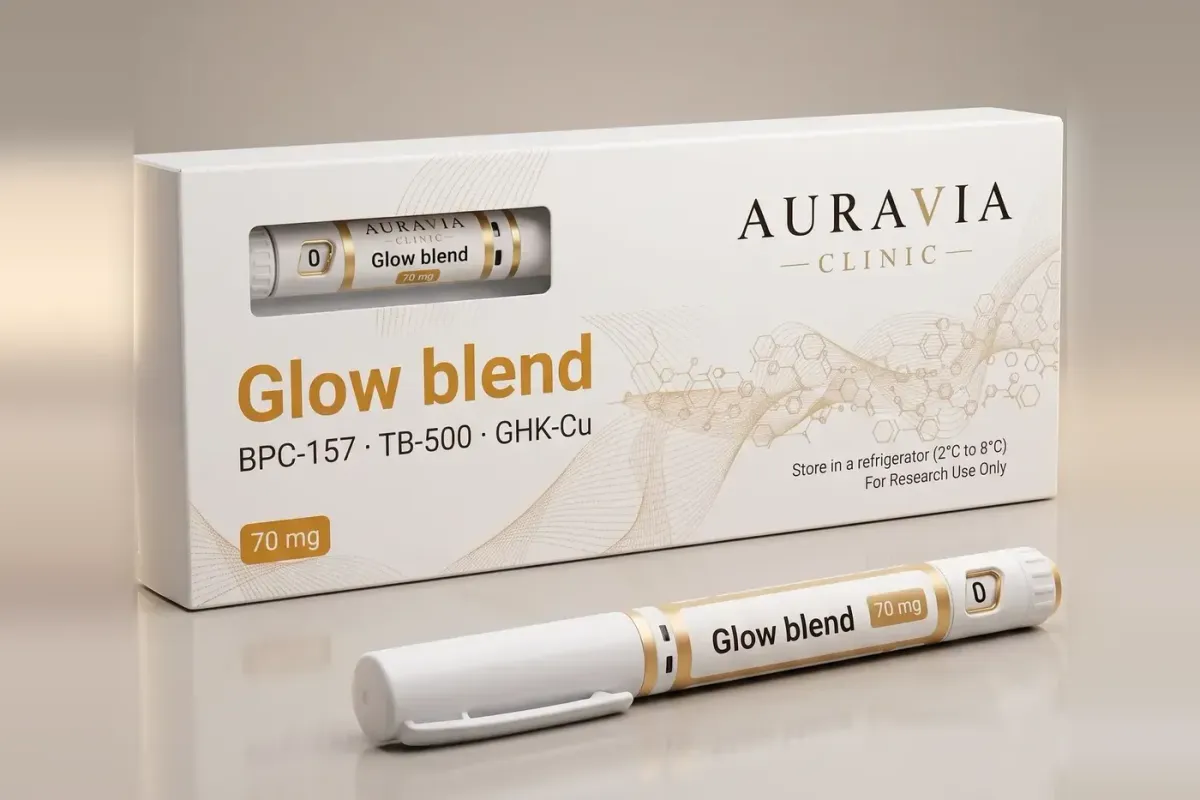
- The Glow pen is a pre-filled pen that holds the Glow blend (BPC-157, TB-500 and GHK-Cu) already in solution, in a sealed cartridge.
- AuraVia Research sells it at €169.99 for 70 mg of blend, with a stated HPLC purity of 99.2%. The product page does not give the split between the three peptides.
- For the same 70 mg, the lyophilised Glow vial costs €99.99 (list price €109.99): the pen costs about 70% more.
- A peptide in solution is less stable than a dry powder, so the pen must stay between 2 and 8 °C, from shipping to storage.
- The Glow blend has no published study of its own and is not an approved medicine: this page gives no usage instructions.
What is the Glow pen?
The Glow pen is a pre-filled injector pen that holds the Glow blend, a combination of three research peptides: BPC-157, TB-500 and GHK-Cu. The peptides are already in solution in a sealed cartridge. Unlike a vial of lyophilised powder, there is nothing to reconstitute: the peptide is already in solution. In our checks on October 19, 2026, the only version on sale is the Glow Pen from AuraVia Research.
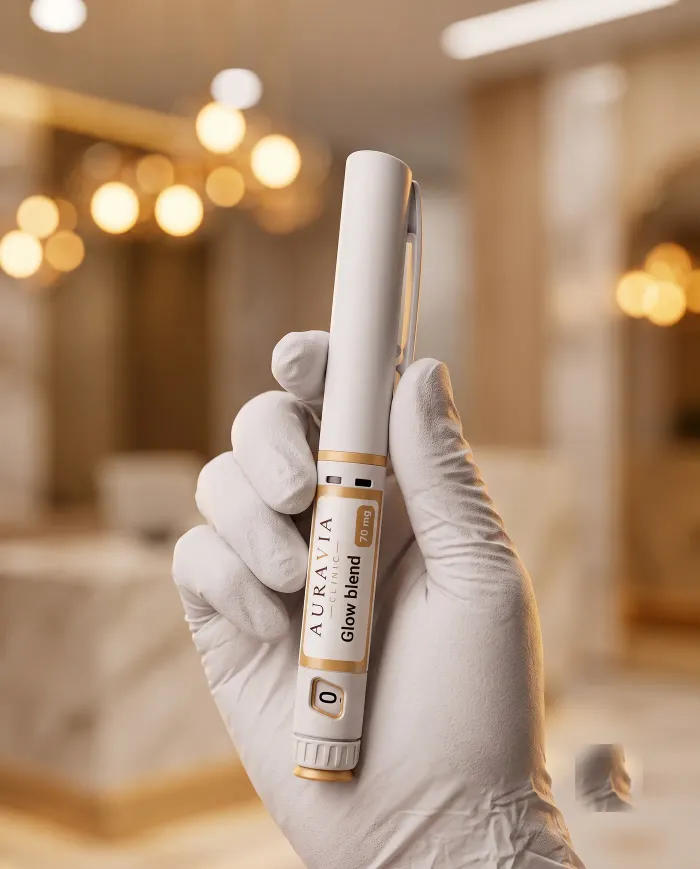
The design comes from insulin pens: a plastic body, a sealed cartridge, a protective cap and a graduated dial mechanism (this page does not describe how to set it). The vendor's product page lists the following characteristics:
- Contents: 70 mg of blend in total (BPC-157 + TB-500 + GHK-Cu).
- Split between the three peptides: not stated on the product page. If you need it, ask the vendor for the batch certificate before you order.
- Form: ready-made solution in a sealed cartridge.
- Storage: refrigerator, between 2 and 8 °C.
- Purity: 99.2% measured by HPLC, with a certificate of analysis (CoA).
- Price: €169.99, VAT included, with no promotion on October 19, 2026.
AuraVia Research also sells single-peptide pens, which we cover on separate pages: the BPC-157 pen and the GHK-Cu pen. Many people also search for a “Klow pen”: in our checks, the Klow blend (which adds KPV to the three Glow peptides) is not sold as a pen.
Glow pen or Glow vial: which costs less per mg?
AuraVia Research sells the Glow blend in two formats with the same amount, 70 mg: the pre-filled pen and the vial of lyophilised (freeze-dried) powder. The table compares the prices checked on October 19, 2026, VAT included.
| Format | Amount | List price | Price on 10/19/2026 | Price per mg |
|---|---|---|---|---|
| Glow Pen (solution) | 70 mg | €169.99 | €169.99 | €2.43 |
| Glow vial (lyophilised powder) | 70 mg | €109.99 | €99.99 | €1.43 |
For the same 70 mg, the pen costs €70 more than the vial at its current price, or about 70% more. Against the vial's list price, the gap is 55%. These prices change often: check the current price on the vendor's site before you order. Our guide pre-filled peptide pen or vial makes the same comparison for every pen that AuraVia Research sells.
Price is not the only difference. Reference reviews on protein pharmaceuticals show that proteins and peptides in solution undergo more degradation reactions (oxidation, aggregation, hydrolysis) than in the dry state (Wang, 1999). This is why the industry freeze-dries fragile molecules (Wang, 2000). In practice, each format implies something different:
- Vial: the dry powder keeps better, but it must be put into solution with a sterile solvent before any experiment, which takes equipment and careful handling.
- Pen: no preparation, but the solution needs an unbroken cold chain, from the vendor's warehouse to your refrigerator.
Where to buy the Glow pen?
In our checks on October 19, 2026, only AuraVia Research sells the Glow blend as a pre-filled pen. The vendor states the following conditions:
- Warehouse: in the European Union, with VAT included in the prices.
- Delivery: standard tracked shipping in 3 to 5 working days.
- Shipping costs: €9 to France, Spain and Portugal, free on orders from €150. At €169.99, the Glow Pen alone is above this threshold.
- Delivery area: European Union only.
- Quality control: a certificate of analysis per batch, with purity measured by HPLC, and the batch number printed on the label.
The pen is not shipped outside the EU. If you live outside the European Union, you can compare vendors of the same peptides in vial form on our page where to buy peptides.
What does research say about the Glow peptides?
No study has been published on the Glow blend as such, and none on its pen format. Research data exist only for each of the three components, studied separately and mostly in cell and animal models. Our article Glow peptide describes the blend in more detail.
- BPC-157 is a synthetic peptide of 15 amino acids derived from a protein found in human gastric juice. Most published work comes from rat models and cell cultures. In one study on rat tendon explants and tendon cells, BPC-157 was associated with tendon outgrowth, cell survival and cell migration (Chang et al., 2011). No phase III human trial has been published.
- TB-500 is a synthetic peptide derived from thymosin beta-4, a 43-amino-acid protein that binds actin, a building block of the cell skeleton. Thymosin beta-4 and a synthetic peptide containing its actin-binding domain promoted skin wound repair in diabetic mice and in aged mice (Philp et al., 2003). Most clinical data concern full thymosin beta-4, not TB-500 (Goldstein et al., 2012).
- GHK-Cu is a copper-binding tripeptide naturally present in human plasma. It is the component most studied in people, mainly as a topical cosmetic ingredient. A review describes the cellular pathways it modulates in skin regeneration (Pickart et al., 2015). This is why searches such as “skin glow pen” point to it, but data on non-topical use remain limited.
Whether the three peptides act together, or interact, has not been tested. None of them is approved as a medicine by the EMA or the FDA.
How to check a Glow pen before you buy
You check a pen the same way as a vial, with a few extra points that come from the solution form.
- Batch and certificate: the batch number on the certificate of analysis must match the one on the pen label or the box.
- HPLC purity: the CoA should give the purity and the date of the test. For a blend, check that the certificate names all three peptides.
- Cold chain: a solution should travel in insulated packaging. Ask the vendor how it ships before you order.
- Label: it should state the contents (70 mg), the volume, the batch number and the expiry date.
- Cartridge: it must arrive sealed and intact.
- Status: a serious vendor states “research use only” and does not present the pen as a medicine.
An unusually low price is a warning sign. A pen needs a cartridge, a mechanism and cold shipping, so it costs more to make than a vial with the same contents.
What is the legal status of the Glow pen?
In the European Union, the Glow pen is sold for laboratory research only. It is not a medicine: neither the blend nor any of its three peptides has a marketing authorisation from the EMA in Europe or from the FDA in the United States, and the vendor states that the product is not for human use. The pen format does not change this status, even if it looks like the pens used for approved medicines such as semaglutide.
TB-500 is also on the World Anti-Doping Agency (WADA) prohibited list, which matters for athletes who are tested. Rules on buying and importing research peptides differ from one country to another: check the rules that apply to you before any order. This page gives no medical advice.
Recommended products
Research peptides selected for quality and purity:
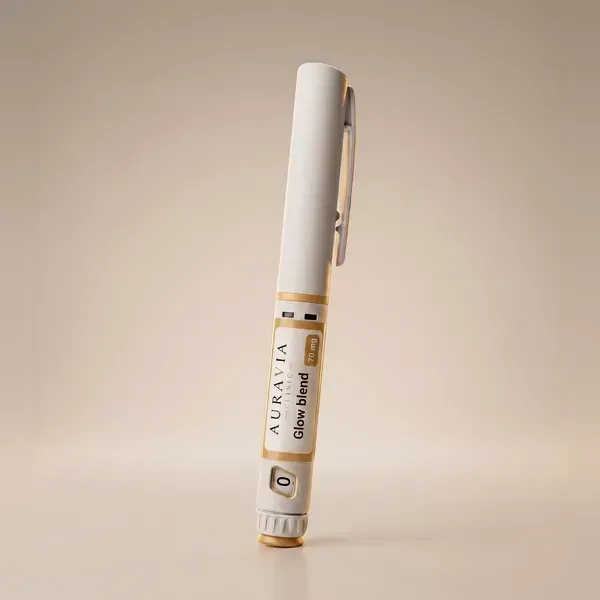
Glow Pen
Pre-filled Pen Glow
Glow Pen
The same stack as 3 separate vials
The Glow Pen ships to Europe only. Build the same stack with the peptides available in your region:

Glow Blend
3-in-1 Regeneration Blend
Glow Blend
The same stack as 3 separate vials
The Glow Blend ships to Europe only. Build the same stack with the peptides available in your region:
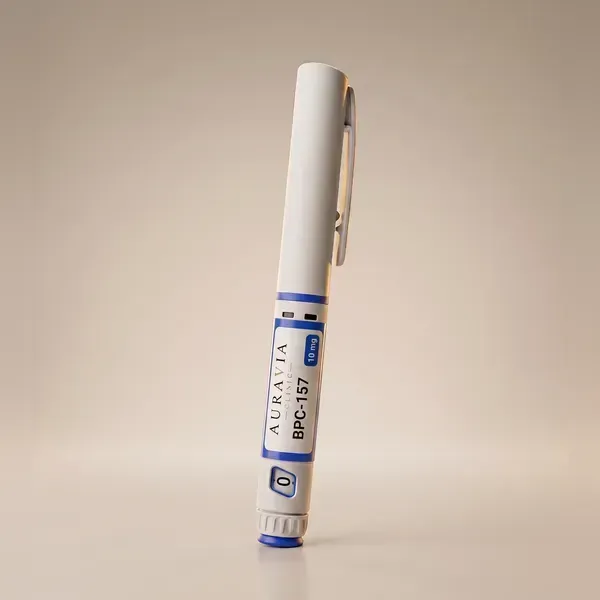
BPC-157 Pen
Pre-filled Pen BPC-157
Test your knowledge
Quick quiz · 6 questions
Peptide Lab: free calculator & tracker
Calculate your reconstitution, track your peptides and injections. Free, no credit card required.
Frequently Asked Questions
What is the difference between the Glow pen and the Glow vial?
How much does the Glow pen cost?
How is the Glow pen stored?
Can the Glow pen be shipped outside the EU?
Is the Glow pen an approved medicine?
Is there a Klow pen?
Sources
- Wang W. (1999). Instability, stabilization, and formulation of liquid protein pharmaceuticals. Int J Pharm, 185(2), 129-188. (PubMed)
- Wang W. (2000). Lyophilization and development of solid protein pharmaceuticals. Int J Pharm, 203(1-2), 1-60. (PubMed)
- Chang CH, Tsai WC, Lin MS, et al. (2011). The promoting effect of pentadecapeptide BPC 157 on tendon healing involves tendon outgrowth, cell survival, and cell migration. Journal of Applied Physiology, 110(3), 774-780. (PubMed)
- Philp D, Badamchian M, Scheremeta B, et al. (2003). Thymosin beta 4 and a synthetic peptide containing its actin-binding domain promote dermal wound repair in db/db diabetic mice and in aged mice. Wound Repair and Regeneration, 11(1), 19-24. (PubMed)
- Goldstein AL, Hannappel E, Sosne G, Kleinman HK. (2012). Thymosin β4: a multi-functional regenerative peptide. Basic properties and clinical applications. Expert Opinion on Biological Therapy, 12(1), 37-51. (PubMed)
- Pickart L, Vasquez-Soltero JM, Margolina A. (2015). GHK peptide as a natural modulator of multiple cellular pathways in skin regeneration. BioMed Research International, 2015, 648108. (PubMed)