
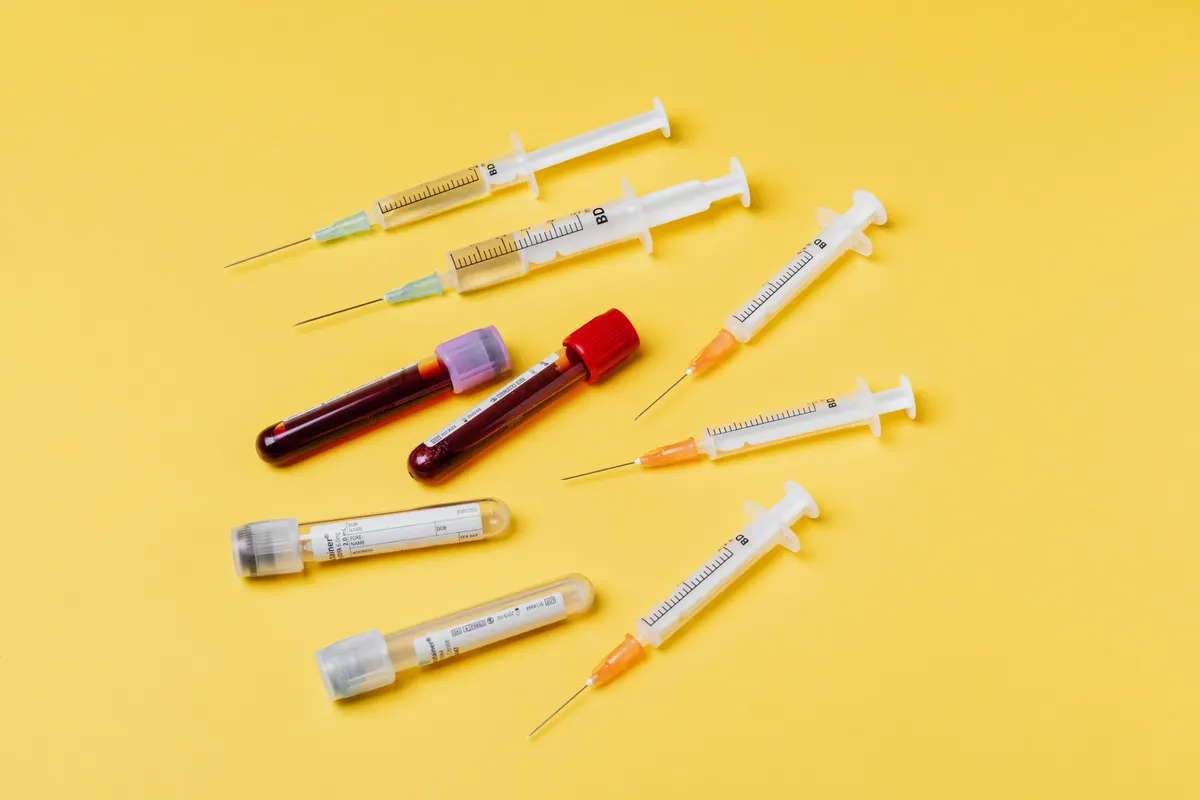
- Lyophilized (freeze-dried) peptides must be dissolved in a sterile solvent (usually bacteriostatic water) before they can be measured or used.
- The golden formula is simple: Concentration (mg/mL) = peptide mass (mg) ÷ solvent volume (mL). Your dose volume = desired dose ÷ concentration.
- Always add the solvent slowly down the side of the vial onto the powder. Never inject the stream directly onto the pellet, and never shake.
- Reconstituted peptides are generally stored refrigerated at 2-8 °C and used within the manufacturer's stated window (often a few weeks).
- Most research peptides are sold 'for research use only' and are not approved by the FDA or EMA for human use; consult a qualified healthcare professional.
Why must lyophilized peptides be reconstituted before use?
Most research peptides are shipped as a small white or off-white pellet at the bottom of a sealed glass vial. This powder is produced by lyophilization (freeze-drying), a process that removes water under vacuum at low temperature. Lyophilization dramatically improves shelf stability because peptides in solution are vulnerable to hydrolysis, oxidation, aggregation, and microbial growth, whereas a dry powder can remain stable for months or years when kept cold and sealed.
Because the peptide is dry, it cannot be measured or administered accurately in that form. A typical vial may contain only 5 mg or 10 mg of material spread invisibly across the glass. Reconstitution is the controlled process of dissolving that powder into a known volume of sterile liquid so that every microgram can be measured precisely with a syringe. Without this step there is no reliable way to know how much peptide is in a given volume.
The choice of solvent matters. The most common diluent is bacteriostatic water: sterile water containing 0.9% benzyl alcohol, which suppresses bacterial growth and allows the reconstituted vial to be used over multiple days. Plain sterile water or 0.9% sodium chloride may be specified for single-use scenarios or for peptides incompatible with benzyl alcohol. Always follow the supplier's certificate of analysis when one is provided.
Understanding the underlying chemistry helps explain the careful technique described later. If you are new to this topic, our overview of what peptides are explains why these molecules are so sensitive to heat, agitation, and pH compared with conventional small-molecule drugs. This article is for educational purposes only and does not constitute medical advice.
What materials do you need to reconstitute a peptide?
Reconstitution is not difficult, but it does require the right equipment and a clean working environment. Gathering everything before you begin reduces the number of times the vials are exposed to air and lowers contamination risk. The core materials are inexpensive and widely available from medical suppliers.
At minimum you will need the following items:
- The lyophilized peptide vial: kept refrigerated until use and allowed to reach room temperature.
- Bacteriostatic water (or the solvent specified by the supplier) in a sealed vial.
- A reconstitution syringe: typically a 1-3 mL syringe with a slightly larger-gauge needle to draw and transfer the solvent.
- Insulin syringes (commonly U-100, 0.3-1 mL) for measuring and, where applicable, administering doses.
- Alcohol swabs (70% isopropyl) to sanitize every rubber stopper before each puncture.
- A clean, flat surface, disposable gloves, and a sharps container for safe needle disposal.
Quality matters more than quantity. Use single-use, individually wrapped sterile syringes and never reuse a needle, as reuse dulls the tip and introduces contamination. Benzyl-alcohol-containing bacteriostatic water should not be used for neonates and may not be appropriate for everyone, which is one of several reasons professional guidance is essential.
A small notebook or a digital tool to record the vial contents, solvent volume, resulting concentration, and reconstitution date is invaluable. Many people use a dedicated calculator to avoid arithmetic errors: see the golden-formula section below and our linked Reconstitution App for an interactive version.
How do you reconstitute a peptide in 5 steps?
The protocol below distills the process into five repeatable steps. Work slowly, keep everything sterile, and never rush the dissolution stage; peptides are fragile and aggressive handling can denature them.
Step 1: Prepare and sanitize. Wash your hands, put on gloves, and clear a clean flat surface. Remove the plastic flip-cap from both the peptide vial and the bacteriostatic water vial, then wipe each exposed rubber stopper with a fresh 70% alcohol swab and let it air-dry. Allow refrigerated vials to come to room temperature so condensation does not form inside.
Step 2: Draw the solvent. Using the reconstitution syringe, draw the calculated volume of bacteriostatic water (see the golden formula below). Insert the needle through the cleaned stopper of the water vial at a slight angle and pull back the plunger to your target volume, removing air bubbles by tapping the barrel.
Step 3: Add solvent to the powder slowly. Insert the needle into the peptide vial and let the liquid run down the inner glass wall, not directly onto the powder pellet. A direct stream can foam and shear the peptide. Release the plunger gently so the vacuum draws the solvent in smoothly.
Step 4: Dissolve gently. Do not shake. Roll or swirl the vial slowly between your fingers, or simply set it down and let the powder dissolve on its own over a few minutes. The solution should turn completely clear. Any visible particles, cloudiness, or persistent foam suggest a problem with the peptide or technique.
Step 5: Label and store. Write the date, concentration, and peptide name on the vial or your log, then refrigerate immediately. Draw individual doses with a clean insulin syringe only when needed. For peptide combinations, our peptide stacking guide explains why some compounds should be reconstituted and stored separately rather than mixed.
How do you calculate peptide dilution with the golden formula?
Dosing errors are the single most common mistake beginners make, and almost all of them come from confusing milligrams (mg), micrograms (mcg), milliliters (mL), and insulin-syringe "units" (IU). The good news is that one simple relationship (the golden formula) resolves every calculation.
The core equation is:
Concentration (mg/mL) = peptide mass in the vial (mg) ÷ solvent volume added (mL)
Once you know the concentration, the volume to inject for any desired dose is:
Dose volume (mL) = desired dose (mg) ÷ concentration (mg/mL)
Because insulin syringes are marked in units (100 IU = 1 mL on a U-100 syringe), it is often easiest to work in micrograms. The worked examples below show how the same 5 mg vial behaves at different solvent volumes:
| Peptide in vial | Bacteriostatic water added | Concentration | For a 250 mcg dose |
|---|---|---|---|
| 5 mg | 1 mL | 5,000 mcg/mL | 0.05 mL = 5 IU |
| 5 mg | 2 mL | 2,500 mcg/mL | 0.10 mL = 10 IU |
| 5 mg | 5 mL | 1,000 mcg/mL | 0.25 mL = 25 IU |
Notice that adding more water does not change the total amount of peptide: it only changes how much liquid contains a given dose. A larger solvent volume makes small doses easier to measure accurately, which is why many people choose 2 mL or more for low-dose protocols. To remove the arithmetic entirely, our interactive Reconstitution App computes concentration and per-dose units instantly once you enter the vial size, solvent volume, and target dose.
Peptide-specific dosing varies widely; figures used for popular research compounds such as BPC-157 or TB-500 are drawn from preclinical animal studies, not approved human protocols. Never extrapolate a dose without consulting a qualified healthcare professional.
What is the correct subcutaneous injection technique?
Where a peptide is used in a research or clinical context, the most common route is subcutaneous (SubQ) injection: into the fatty layer just beneath the skin. This route is favored because it is simple, the absorption is relatively slow and steady, and the small-gauge insulin needles involved cause minimal discomfort. The following description is provided strictly for educational completeness.
Common subcutaneous sites include the abdomen (a couple of centimeters away from the navel), the outer thigh, and the upper buttock. Rotating injection sites with each administration prevents local irritation, bruising, and the formation of fibrous tissue (lipohypertrophy) that can impair absorption over time.
The general technique involves cleaning the site with an alcohol swab, allowing it to dry, gently pinching a fold of skin, and inserting the needle at roughly a 45-90° angle depending on needle length and body composition. The plunger is depressed slowly and steadily, after which the needle is withdrawn and the site is covered briefly with clean gauze. Used needles go directly into a sharps container.
Sterility is non-negotiable. Each needle should be used only once, every stopper should be swabbed before puncture, and the work area should be clean. Signs of infection (spreading redness, warmth, swelling, pus, or fever) warrant immediate medical attention. This is for educational purposes only; only a licensed clinician can determine whether any injection is appropriate for a given individual. Consult a healthcare professional before considering any peptide administration.
How should reconstituted peptides be stored?
Storage conditions are decisive for peptide integrity. The freeze-dried powder and the reconstituted solution have very different stability profiles, and confusing the two leads to wasted material and unreliable dosing. Stability of protein and peptide pharmaceuticals is well documented in the formulation literature, and the same principles apply to research peptides.
Before reconstitution, lyophilized peptides are typically kept in a freezer (around −20 °C) for long-term storage, or refrigerated for shorter periods, always sealed and protected from light and moisture. In dry form, well-characterized peptides can remain stable for many months.
After reconstitution, the peptide is in solution and far more vulnerable. The general recommendation is refrigeration at 2-8 °C, protected from light, and use within the window stated by the supplier, frequently a few weeks, though this varies by compound. Bacteriostatic water extends usable life by inhibiting microbial growth, but it does not stop chemical degradation such as oxidation or aggregation.
A few practical rules protect potency: avoid repeated freeze-thaw cycles, which mechanically stress the molecule; never leave a reconstituted vial at room temperature longer than necessary; and discard any solution that becomes cloudy, discolored, or develops particulates. The table below summarizes typical conditions, but always defer to the manufacturer's documentation.
| State | Typical temperature | Approximate window |
|---|---|---|
| Lyophilized (long-term) | −20 °C, sealed, dark | Months to years |
| Lyophilized (short-term) | 2-8 °C | Weeks |
| Reconstituted | 2-8 °C, dark | Days to a few weeks |
What are the most common reconstitution mistakes to avoid?
Even careful beginners tend to repeat the same handful of errors. Recognizing them in advance is the easiest way to protect both the peptide and yourself. The mistakes below account for the large majority of failed or wasted preparations.
Shaking the vial. Vigorous shaking generates foam and shear forces that can denature or aggregate the peptide, reducing potency. Always swirl gently or let the powder dissolve passively.
Spraying solvent onto the pellet. A fast, direct stream of water onto the powder causes splashing and foaming. Direct the solvent down the glass wall so it pools gently over the peptide.
Dosing math errors. Mixing up mcg and mg, or misreading insulin units, can produce a tenfold dosing error. Use the golden formula and verify with the Reconstitution App before drawing any dose.
Other frequent errors include skipping the alcohol swab, reusing needles, leaving reconstituted vials at room temperature, using the wrong solvent, and failing to label the vial with concentration and date. Using overheated or expired bacteriostatic water, or injecting an unfiltered cloudy solution, are also avoidable hazards. When in doubt, stop and re-check rather than proceed, and review our medical disclaimer for important limitations on this educational content.
Is peptide reconstitution legal and safe?
The reconstitution technique itself is straightforward laboratory practice, but the broader context (what is being reconstituted and why) carries significant legal and safety considerations that vary by jurisdiction. It is essential to understand these before handling any peptide.
Most research peptides discussed online are sold strictly "for research use only" and are not approved by the FDA, EMA, or equivalent regulators for human use. Compounds such as BPC-157 and TB-500 have been studied largely in animal and preclinical models; there are essentially no completed Phase III human clinical trials establishing their safety or efficacy. Marketing them for human consumption can be illegal, and several regulators have issued warning letters to non-compliant sellers.
Product quality is another major concern. Without third-party testing, a vial may contain less peptide than labeled, the wrong compound, or contaminants. Independent certificates of analysis, purity data (often by HPLC and mass spectrometry), and reputable sourcing reduce (but do not eliminate) this risk.
Finally, individual safety depends on factors only a clinician can assess: existing conditions, medications, allergies (including to benzyl alcohol), and sterile-technique competence. This article is for educational purposes only and is not medical advice. Peptides referenced here are research compounds, not approved treatments. Always consult a qualified healthcare professional, and be aware that legal status varies by country and region.
Recommended products
Research peptides selected for quality and purity:
GHK-Cu
Anti-Aging Compound
Test your knowledge
Quick quiz · 6 questions
Peptide Lab: free calculator & tracker
Calculate your reconstitution, track your peptides and injections. Free, no credit card required.
Frequently Asked Questions
What water should I use to reconstitute a peptide?
How much bacteriostatic water should I add?
Why should I never shake a peptide vial?
How long does a reconstituted peptide last?
Are reconstituted research peptides safe and legal to use?
Sources
- Frokjaer S, Otzen DE (2005). Protein drug stability: a formulation challenge. Nature Reviews Drug Discovery.
- Manning MC, Chou DK, Murphy BM, Payne RW, Katayama DS (2010). Stability of protein pharmaceuticals: an update. Pharmaceutical Research.
- Wang W (2000). Lyophilization and development of solid protein pharmaceuticals. International Journal of Pharmaceutics.
- Sikiric P, Seiwerth S, Rucman R, et al. (2018). Novel Cytoprotective Mediator, Stable Gastric Pentadecapeptide BPC 157. Vascular Recruitment and Gastrointestinal Tract Healing. Current Pharmaceutical Design.
- Chang CH, Tsai WC, Lin MS, Hsu YH, Pang JS (2011). The promoting effect of pentadecapeptide BPC 157 on tendon healing involves tendon outgrowth, cell survival, and cell migration. Journal of Applied Physiology.
- Meyer JD, Nayar R, Manning MC (2009). Impact of bulking agents on the stability of a lyophilized monoclonal antibody. European Journal of Pharmaceutical Sciences.