
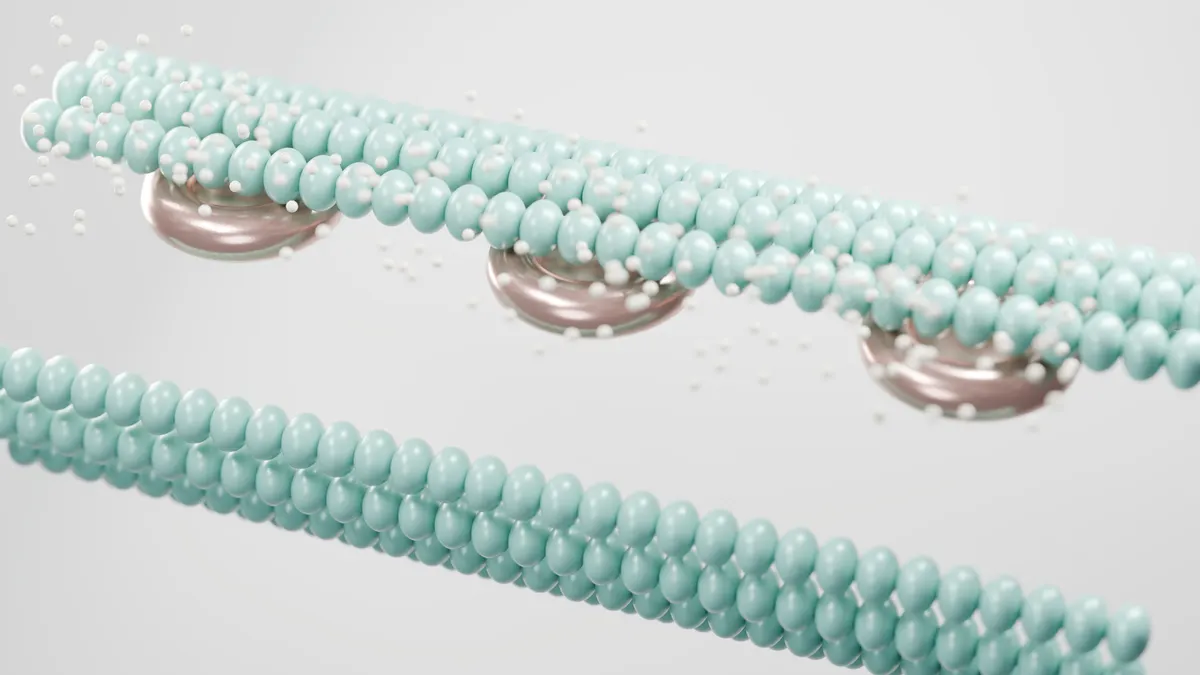
- Biotinoyl tripeptide-1 is the INCI name for biotinyl-GHK: the tripeptide Gly-His-Lys with a biotin molecule attached, molecular weight 566.67 g/mol, CAS 299157-54-3.
- It is not biotin, and it is not a copper peptide. There is no copper ion in the molecule, which makes it chemically distinct from GHK-Cu despite sharing the same peptide backbone.
- Procapil is a trade name for a blend, not a synonym. The Sederma composition is butylene glycol, water, PPG-26-buteth-26, PEG-40 hydrogenated castor oil, apigenin, oleanolic acid and biotinoyl tripeptide-1, typically used at 3%.
- No published, peer-reviewed human trial has tested biotinoyl tripeptide-1 on its own. Every clinical dataset available uses it inside a multi-ingredient formula, and the efficacy figures most often quoted online come from manufacturer documents rather than indexed journals.
- The peptide is listed in the EU cosmetic ingredient inventory with a hair conditioning function, and no specific safety restriction. Reported tolerance in the published trials is good, but those trials were short and small.
- Treat it as a plausible supporting ingredient with thin independent evidence, not as a substitute for a treatment with regulatory approval. This article is educational and is not medical advice.
What is biotinoyl tripeptide-1, and what does the INCI name tell you?
If you have read the back of a hair serum or a scalp lotion in the last few years, you have probably seen the words biotinoyl tripeptide-1 near the bottom of the ingredient list. That string is an INCI name, the standardized nomenclature used on cosmetic packaging in the European Union, the United States and most other markets. It is not a brand name, and it is not a marketing invention: it describes a specific molecule.
Read it in two halves. Tripeptide-1 is the INCI designation for Gly-His-Lys (glycine, histidine, lysine), a three amino acid sequence that occurs naturally in human plasma and in the extracellular matrix. Biotinoyl means that a molecule of biotin, vitamin B7, has been covalently attached to that peptide through an amide bond at the glycine end. The result is a single hybrid molecule, usually written in the literature as biotinyl-GHK.
The chemistry is well characterized. The compound carries CAS number 299157-54-3, PubChem CID 11534242, and the UNII code O6380721VA. Its molecular formula is C₂₄H₃₈N₈O₆S and its molecular weight is 566.67 g/mol. Some supplier listings quote slightly different formulas, such as C₂₆H₄₂N₈O₈S, because they are describing an acetate or trifluoroacetate salt form rather than the free peptide. If you are comparing certificates of analysis, that is the usual explanation for the discrepancy.
At 566.67 g/mol the molecule sits in a size range where topical delivery is at least conceivable, though delivery through the stratum corneum or down a hair follicle is never a given for a charged peptide, and formulation matters enormously. The biotin portion is lipophilic relative to the peptide portion, and ingredient suppliers present that as one reason for the conjugation, on the basis that it should improve affinity for the follicular environment compared with the bare tripeptide.
In regulatory terms, biotinoyl tripeptide-1 is a cosmetic ingredient. Third-party INCI databases citing the European Commission's CosIng inventory list it under a single declared function, hair conditioning, with no concentration restriction or annex listing. It is not an approved drug for hair loss in any major jurisdiction, and a cosmetic claim about appearance is legally a very different thing from a therapeutic claim about treating alopecia. Keep that distinction in mind when you read product pages.
How is it different from biotin and from copper peptides like GHK-Cu?
This is where most confusion starts, because three related names circulate in hair care marketing and they are not interchangeable. Biotinoyl tripeptide-1 borrows one component from each of two better known ingredients, yet behaves as its own molecule.
Biotin is a water soluble B vitamin, a cofactor for carboxylase enzymes involved in fatty acid synthesis and amino acid metabolism. Biotin deficiency genuinely causes hair thinning and brittle nails. The problem is the leap from that fact to the idea that extra biotin improves hair in people who are not deficient. A review in Skin Appendage Disorders found 18 reported cases of biotin use for hair and nail changes, and in every single one the patient had an underlying pathology causing the poor growth. The authors concluded that there is a lack of sufficient evidence for supplementation in healthy individuals. Attaching biotin to a peptide for topical use is a different proposition again, and the oral evidence does not transfer to it.
GHK is the peptide half. It is a naturally occurring human tripeptide whose plasma concentration declines with age, from roughly 200 ng/mL around age 20 to substantially lower levels in later decades, as described in Pickart's review work. GHK has a high affinity for copper(II), and the copper complexed form, GHK-Cu, is the version with the largest research literature behind it, covering wound healing, collagen and metalloproteinase regulation, and broad gene expression effects. If that is what you came for, the dedicated GHK-Cu guide and the article on GHK-Cu and hair growth cover it in depth.
The critical point for this page: biotinoyl tripeptide-1 contains no copper. The formula C₂₄H₃₈N₈O₆S has no metal in it. Because the biotin group occupies the N-terminal amine of the glycine residue, the classic copper binding site of GHK is modified. It is therefore not accurate to describe biotinyl-GHK as a copper peptide, or to assume that the GHK-Cu literature applies to it directly. That assumption is common on retail pages and it is the single most frequent error about this ingredient.
| Ingredient | What it is | Copper? | Evidence base |
|---|---|---|---|
| Biotin | Vitamin B7, enzyme cofactor | No | Strong for deficiency correction, weak for healthy individuals |
| Tripeptide-1 (GHK) | Natural human tripeptide | No | Mostly studied as the copper complex |
| GHK-Cu (copper tripeptide-1) | GHK bound to copper(II) | Yes | Largest literature of the three, mostly in vitro and small clinical |
| Biotinoyl tripeptide-1 | Biotin covalently bonded to GHK | No | Thin: no standalone published human trial |
Is biotinoyl tripeptide-1 the same thing as Procapil?
No, and this matters for reading evidence correctly. Procapil is a trade name owned by Sederma (part of Croda) for a finished cosmetic active blend. Biotinoyl tripeptide-1 is one ingredient inside that blend.
According to Sederma's technical documentation, the INCI composition of Procapil is: butylene glycol, water, PPG-26-buteth-26, PEG-40 hydrogenated castor oil, apigenin, oleanolic acid, and biotinoyl tripeptide-1. The first four are solvent and solubilizer systems. The three actives are apigenin (a flavonoid found in plants such as chamomile and parsley), oleanolic acid (a triterpenoid that ingredient literature associates with 5-alpha-reductase inhibition), and the peptide. Suppliers typically recommend a use level of around 3% of the blend in a finished formula, which means the actual concentration of the peptide in your bottle is a small fraction of that 3%.
The practical consequence is a causal attribution problem. Any study of Procapil is a study of three actives at once. If a Procapil lotion improves a trichogram parameter, the result cannot be assigned to biotinoyl tripeptide-1 rather than to oleanolic acid, to apigenin, to the vehicle, or to the massage involved in applying it. Marketing copy routinely collapses this distinction and presents Procapil data as peptide data. It is not.
A second layer of the same problem: most finished products do not stop at Procapil. Commercial hair serums frequently stack it with redensyl, capixyl, caffeine, adenosine, saw palmetto, ginkgo and minoxidil. The clinical literature reflects this, and almost every trial you will find tests one of these combinations. That makes the formulas commercially interesting and the evidence scientifically difficult to parse.
So when a product page says "clinically proven," the useful follow-up question is: proven as what, exactly? As a 3% Procapil lotion? As an eight-ingredient serum? Against placebo, or against nothing? Over four months in 35 people, or over six months in 56? Those answers change the weight of the claim considerably, and we go through them in the evidence section below.
What mechanism is proposed for biotinyl-GHK in the hair follicle?
The mechanistic story told by ingredient suppliers has three strands. It is worth stating clearly up front that these are proposed mechanisms, built largely on in vitro observations and on reasoning transferred from the parent GHK peptide, not on demonstrated in vivo activity of biotinyl-GHK in human scalp.
The first strand is the matrikine concept. Matrikines are peptide fragments released from extracellular matrix proteins that act as signaling molecules, influencing cell behavior through receptor-mediated pathways rather than simply serving as building blocks. GHK is one of the most studied examples. Reviews of the parent peptide describe effects on collagen synthesis and breakdown, on metalloproteinases and their inhibitors, and on the expression of large numbers of human genes. Sederma describes biotinyl-GHK as a "vitaminated matrikine," meaning a matrikine with a vitamin attached. The implied mechanism is that the peptide signals to the cells of the follicle and the surrounding dermis.
The second strand is follicular anchoring. Supplier documentation attributes to the peptide an improvement in the quality of the structures that hold the hair shaft in the scalp, specifically the extracellular matrix proteins of the follicular basement membrane such as collagen IV and laminin. In the proposed model, better anchoring means less shedding, which is why Procapil is positioned as an anti-hair-fall ingredient rather than a hair growth stimulant. That is an important nuance: the claimed endpoint is retention, not regrowth. This data is manufacturer generated and, as far as we could verify, has not been published in an indexed peer-reviewed journal.
The third strand is nutritional, and it is the weakest. The argument runs that biotin delivered by the conjugate supports keratinocyte metabolism in the hair matrix. There is no published evidence that topical biotinyl-GHK releases meaningful free biotin at the follicle, or that follicular biotin status is limiting in people with normal nutrition. Treat this strand as a hypothesis.
For context, a related but distinct copper tripeptide, AHK-Cu, was studied in human hair follicles ex vivo and in cultured dermal papilla cells, with reported stimulation of follicle elongation and dermal papilla proliferation (Pyo and colleagues, Archives of Pharmacal Research, 2007). That is a different molecule with a copper center, and it is cited here only to illustrate the kind of preclinical work that exists for peptide-copper complexes and does not yet exist for biotinyl-GHK in isolation. Our broader overview of peptides studied for hair growth sets these molecules side by side.
What do human studies actually show, and what do they not show?
Here is the honest summary: there is no published, peer-reviewed randomized trial of biotinoyl tripeptide-1 administered on its own. Everything below tests it inside a multi-ingredient formula, which means none of it can isolate the peptide's contribution. We have separated the sources by type so you can weigh them yourself.
Manufacturer data (not peer reviewed). Sederma's technical literature describes short placebo-controlled trichogram or videotrichogram studies of a 3% Procapil lotion over roughly four months in small groups of volunteers. Different secondary documents circulating online report different sample sizes (figures in the range of 35 to 42 participants appear in different versions), different split between active and placebo arms, and different headline percentages. We were unable to trace the widely quoted figures (such as a 46% improvement in the anagen to telogen ratio, or 67% of subjects improving) to any peer-reviewed publication or to a single consistent primary document. Until the underlying dataset is published, those numbers should be read as promotional claims, not as study results.
Open-label clinical data (peer reviewed journal, uncontrolled). Garre and colleagues published a six-month open-label prospective study in the Journal of Cosmetology and Trichology (2018) of a topical lotion containing oleanolic acid, apigenin, biotinyl tripeptide-1, diaminopyrimidine oxide, adenosine, biotin and Ginkgo biloba, in adults with androgenetic alopecia or telogen effluvium. Fifty-six patients completed the study. The authors reported increases in total and anagen hair counts, and patient self-assessment responses including reduced hair loss (79%), increased confidence about their hair (86%) and the problem being less visible (79%), with no adverse events recorded. The design has no control arm, no blinding and seven actives, so it demonstrates that the formula was tolerated and that patients reported improvement, not that the peptide caused it.
Comparative clinical data (PubMed indexed). A randomized study published in Cureus in 2023 compared topical Procapil with platelet-rich plasma against topical redensyl, saw palmetto and biotin with platelet-rich plasma in 54 men with androgenetic alopecia, 27 per arm, across four PRP sessions at three week intervals. The authors reported a statistically significant difference between the two groups on the androgenetic alopecia grading score (P < 0.05), with the result not favoring the Procapil arm. Both arms received PRP, so this tells you something about relative performance of two adjunct topicals and nothing about either one against placebo.
A prospective study by Bansal and Bansal, published in the Journal of General-Procedural Dermatology and Venereology Indonesia in 2024, enrolled 110 adults aged 18 to 60 with androgenetic alopecia using a serum containing procapil, redensyl, capixyl, bicapil and anagain, and reported improvement in hair density with no documented adverse effects. Again: five actives, no control arm. A 2025 review in the International Journal of Trichology surveying topical alternatives for hair loss includes this class of ingredients while noting the general weakness of the evidence base for non-conventional topicals.
What this adds up to. Consistent signals of acceptable tolerance across several hundred participants. Repeated reports of patient-perceived improvement. Zero isolation of the peptide, no placebo-controlled peer-reviewed trial of it, and no data comparing it with established options under rigorous conditions. That is a reasonable basis for considering it a supporting cosmetic ingredient. It is not a basis for expecting it to perform like a regulated hair loss medication. This article is educational only and is not medical advice; anyone with progressive hair loss should consult a dermatologist or qualified healthcare professional for diagnosis.
Does biotinoyl tripeptide-1 do anything for skin, or only for hair?
The ingredient was developed and is marketed for scalp and hair applications, and that is where essentially all of its data sits. You will nonetheless find it in a handful of eyelash and eyebrow serums, and occasionally in facial products, so the question is fair.
Regulatory classification is one clue to intent. Third-party databases drawing on the EU cosmetic ingredient inventory list a single function for biotinoyl tripeptide-1: hair conditioning. Ingredients with demonstrated facial skincare positioning normally also carry a skin conditioning function. The absence is not proof that the molecule does nothing on skin, but it reflects how it has been registered and promoted.
Mechanistically, there is a reasonable argument that the GHK backbone is relevant to skin, because the parent peptide's literature is overwhelmingly dermatological: collagen synthesis, matrix remodeling, wound repair, antioxidant signaling. The catch is that in most of that work GHK is present as the copper complex, and the biotinoyl modification changes the molecule. Transferring skin claims from GHK-Cu to biotinyl-GHK is an inference, not a finding.
Where you are most likely to meet it on the face is in brow and lash conditioners, which is consistent with the hair positioning rather than a departure from it. Those products are cosmetic conditioners; lash growth claims in that category are generally not supported by the kind of controlled data that exists for prescription prostaglandin analogues. If you are building a facial routine around peptides, the broader families (signal peptides such as palmitoyl pentapeptide-4, neurotransmitter-affecting peptides such as acetyl hexapeptide-8, and carrier peptides) have more relevant evidence, and our guide to cosmetic peptides maps out which does what.
A practical reading: if a facial serum contains biotinoyl tripeptide-1 alongside other actives you actually want, its presence is not a problem. If it is the headline ingredient of a face product, the positioning is ahead of the evidence.
How well tolerated is it, and where are the real limits?
Tolerance, as reported, is the strongest part of this ingredient's profile. Across the published studies described above, covering well over a hundred participants using multi-ingredient topicals for four to six months, investigators reported no adverse events attributable to the formulas. The ingredient carries no restriction or concentration limit in the EU cosmetic inventory, and it does not appear on allergen declaration lists.
Those reassurances come with the standard caveats. Short studies in small, selected populations cannot detect uncommon reactions. None of the studies tested the peptide alone, so a reaction to a Procapil lotion could be caused by the PEG-40 hydrogenated castor oil, the butylene glycol, a fragrance, or a preservative rather than by the peptide. As with any leave-on scalp product, contact dermatitis is possible, and patch testing a small area before full use is a sensible precaution. There is no safety data for use during pregnancy or breastfeeding, and no data in children.
The substantive limits are about evidence rather than safety:
- No isolated human trial. Not one published study tests biotinoyl tripeptide-1 without other actives.
- No dose-response data. Nobody has published what concentration of the peptide is needed on scalp, which means label order tells you very little.
- No delivery data. Whether a 567 Da peptide reaches the follicular bulge or dermal papilla from a cosmetic lotion in biologically relevant amounts has not been demonstrated in humans.
- Attribution to Procapil. Even the manufacturer dataset tests a three-active blend, and its primary numbers are not in the peer-reviewed literature.
- Comparator gap. The one PubMed-indexed randomized comparison did not favor the Procapil arm, and no trial has compared it with an approved topical under blinded conditions.
A balanced way to hold all this: biotinoyl tripeptide-1 is a low-risk cosmetic ingredient with a plausible rationale and thin independent support. For cosmetic goals such as the look and feel of hair and reduced perceived shedding, it is a defensible component of a formula. For diagnosed androgenetic alopecia or any progressive or sudden hair loss, it is not an alternative to medical evaluation, and nothing in this article should be read as treatment advice. Hair loss can signal thyroid disease, iron deficiency, autoimmune conditions and other causes that a cosmetic will not address.
How do you spot biotinoyl tripeptide-1 on an ingredient list?
Ingredient lists are the one piece of product information that is legally standardized, so they are worth learning to read. Here is what to look for.
Look for the INCI name itself. On an EU or US label the entry will read exactly Biotinoyl Tripeptide-1. Some lists use the variant spelling Biotinyl Tripeptide-1, which refers to the same molecule, and clinical papers often use biotinyl-GHK. Procapil is a trade name and cannot legally replace the INCI entries on the list, so if a product contains Procapil you will see its components spelled out individually.
Look for the Procapil signature. Because Procapil is supplied as a blend, its ingredients appear as a contiguous cluster in the list, usually in this order: butylene glycol, water, PPG-26-buteth-26, PEG-40 hydrogenated castor oil, apigenin, oleanolic acid, biotinoyl tripeptide-1. If you see apigenin and oleanolic acid sitting next to biotinoyl tripeptide-1, you are almost certainly looking at Procapil rather than at the peptide added on its own. That distinction matters if you are trying to work out which evidence, if any, applies to the product in your hand.
Read the position, with caution. Ingredients are listed in descending order of concentration down to 1%, below which they may be listed in any order. Peptides are used at fractions of a percent, so biotinoyl tripeptide-1 will essentially always appear near the end. Its position therefore tells you almost nothing about whether the amount is adequate, and a brand that volunteers an actual use level (for example, "3% Procapil") is giving you more information than one that does not.
Note what else is in there. Most serums containing this peptide also contain redensyl, capixyl, caffeine, adenosine or saw palmetto. If you are evaluating a product, evaluate the whole formula, and be aware that a single stack of ingredients makes it impossible to attribute any result you observe to one of them. If you want to understand how these multi-peptide formulas are constructed and what each component is claimed to do, our comprehensive review of hair peptides covers the full category.
Finally, a note on claims. Expect language about appearance, feel, shine and "anti-hair-fall" positioning. A cosmetic cannot legally claim to treat alopecia in most jurisdictions, and a product making that claim is either a regulated drug or is out of compliance.
Frequently Asked Questions
Is biotinoyl tripeptide-1 the same as biotin?
Is biotinoyl tripeptide-1 a copper peptide?
Is Procapil just another name for biotinoyl tripeptide-1?
Are there human trials on biotinoyl tripeptide-1 by itself?
Where do the percentage figures quoted for Procapil come from?
How long would you need to use a product containing it before judging anything?
Can biotinoyl tripeptide-1 replace minoxidil or finasteride?
Is it safe to use on the scalp every day?
Recommended products
Research peptides selected for quality and purity:

GHK-Cu
Anti-Aging Compound
GHK-Cu Pen
Pre-filled Pen GHK-Cu
GLOW-UP Ritual
3-pen pack: Glow, NAD+, GHK-Cu
Test your knowledge
Quick quiz · 6 questions
Sources
- Patel DP, Swink SM, Castelo-Soccio L (2017). A Review of the Use of Biotin for Hair Loss. Skin Appendage Disorders (PMID 28879195). (PubMed)
- Pickart L, Margolina A (2018). Regenerative and Protective Actions of the GHK-Cu Peptide in the Light of the New Gene Data. International Journal of Molecular Sciences, 19(7):1987 (PMID 29986520). (PubMed)
- Pickart L, Vasquez-Soltero JM, Margolina A (2015). GHK Peptide as a Natural Modulator of Multiple Cellular Pathways in Skin Regeneration. BioMed Research International, 2015:648108 (PMID 26236730). (PubMed)
- Pavithra TR, Rajashekar TS, Prasanna H (2023). A Comparative Study of Topical Procapil With Platelet-Rich Plasma Therapy Versus Topical Redensyl, Saw Palmetto, and Biotin With Platelet-Rich Plasma Therapy in the Treatment of Androgenetic Alopecia. Cureus, 15(5):e38696 (PMID 37292551). (PubMed)
- Bikash C (2025). Topical Alternatives for Hair Loss: Beyond the Conventional. International Journal of Trichology, 17(1):13-19 (PMC12251978). (PMC)
- Skibska A (2021). Signal Peptides: Promising Ingredients in Cosmetics. Current Protein and Peptide Science, 22(10):716-728 (PMID 34382523). (PubMed)
- Garre A, Piquero-Casals J, et al. (2018). Efficacy and Safety of a New Topical Hair Loss-Lotion Containing Oleanolic Acid, Apigenin, Biotinyl Tripeptide-1, Diaminopyrimidine Oxide, Adenosine, Biotin and Ginkgo biloba in Patients with Androgenetic Alopecia and Telogen Effluvium: A Six-month Open-Label Prospective Clinical Study. Journal of Cosmetology and Trichology, 4(1), DOI 10.4172/2471-9323.1000132 (not indexed in PubMed).
- Bansal G, Bansal R (2024). A prospective study in the treatment of androgenic alopecia using combination of procapil, capixyl, redensyl. Journal of General-Procedural Dermatology and Venereology Indonesia, 8(2) (not indexed in PubMed).
- Pyo HK, Yoo HG, Won CH, Lee SH, Kang YJ, Eun HC, Cho KH, Kim KH (2007). The effect of tripeptide-copper complex on human hair growth in vitro. Archives of Pharmacal Research, 30(7):834-839.
- Sederma (Croda) (2016). Procapil technical brochure: composition and in-house clinical evaluation (manufacturer document, not peer reviewed). Sederma / Croda technical literature.