
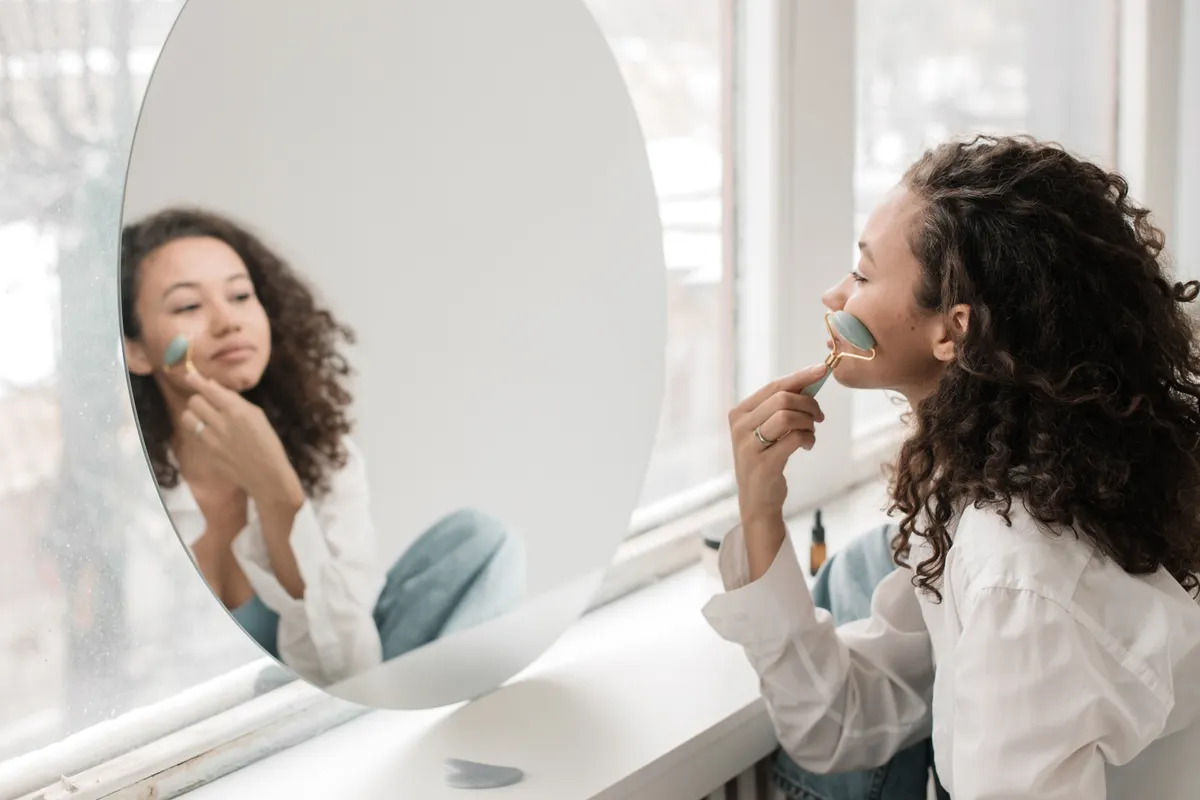
- Most cosmetic GHK-Cu serums use concentrations in the roughly 0.05% to 2% range, with many well-known formulas sitting between 0.1% and 1%.
- GHK-Cu is generally best applied on clean skin before heavier creams, allowing a short absorption window before layering other products.
- The copper ion is a redox-active metal, so strong direct-acid antioxidants like L-ascorbic acid are best separated by time of day or by a waiting period to reduce potential destabilization.
- GHK-Cu and retinol are often used successfully together, but alternating evenings or separating them (one AM, one PM) is a common way to limit irritation.
- A 24 to 48 hour patch test on the inner forearm and cool, dark storage help preserve tolerance and product stability.
- Topical GHK-Cu is a cosmetic use case and is very different from injectable or reconstituted research forms, which fall outside skincare and carry different considerations.
What Is GHK-Cu and Why Is It Used Topically?
GHK-Cu is a small copper-binding tripeptide made of three amino acids, glycine, histidine, and lysine, bound to a copper(II) ion. It was first isolated by biochemist Loren Pickart in 1973 from human plasma, where the free GHK peptide naturally circulates. Plasma GHK levels are estimated at roughly 200 ng/mL around age 20 and decline steadily with age, which is part of why the molecule attracted interest as a signal linked to youthful tissue repair.
In skincare, GHK-Cu is valued because it acts as a carrier that delivers bioavailable copper to the skin while also functioning as a signaling peptide. Laboratory and fibroblast studies have reported that GHK-Cu can stimulate collagen and other extracellular matrix components, with some cell studies describing collagen synthesis increases of up to 70%. Gene expression research has suggested that GHK-Cu can influence a broad set of genes involved in tissue remodeling and antioxidant defense, which is frequently cited to explain its appeal in anti-aging formulas.
It is important to separate documented laboratory findings from finished-product marketing. Much of the strongest data comes from cell culture and small studies, and cosmetic serums are not medicines. When you read that GHK-Cu supports firmness or skin renewal, that reflects mechanistic and early clinical research rather than a guarantee of results for any individual. This guide focuses on how the ingredient is used in practice, not on medical dosing.
If you want a deeper scientific profile of the molecule itself, see our dedicated GHK-Cu monograph. For broader background on how peptides work in skin, our overview of peptides for skin is a useful companion. This article assumes you already have a GHK-Cu serum and want to know how to use it well.
What Concentrations Are Documented in the Literature?
Topical GHK-Cu appears in cosmetic products across a fairly wide concentration band. In practice, most commercial serums fall somewhere in the range of roughly 0.05% to 2%, and many recognizable formulas sit between 0.1% and 1%. Some professional or higher-strength products push toward the upper end of that band, while gentle daily serums stay lower. There is no single official cosmetic dose, because GHK-Cu is used as an active ingredient rather than a regulated drug.
Higher is not automatically better. Copper peptides are potent signaling molecules, and formulation quality (pH, stabilizers, delivery system, and the rest of the ingredient list) often matters as much as the raw percentage on the label. A well-formulated 0.5% serum can outperform a poorly stabilized 2% one. Concentration also interacts with tolerance: some people find higher-strength copper peptides more likely to cause a temporary tingling or a metallic feel.
Here is a general orientation to how concentrations are typically positioned in cosmetic products:
| Concentration band | Typical positioning | Common use |
|---|---|---|
| 0.05% to 0.2% | Gentle, entry level | Daily use, sensitive skin, beginners |
| 0.2% to 1% | Standard serum strength | Most anti-aging serums |
| 1% to 2% | Higher strength | Experienced users, targeted routines |
When you are new to GHK-Cu, starting at the lower end and building up is a sensible approach. This lets you gauge tolerance before committing to a stronger product. For a broader look at how copper peptides compare with other ingredients on a serum shelf, our roundup of the best peptide serums gives useful context. Remember that this is educational information, not a personalized recommendation.
Where Does GHK-Cu Fit in Your Routine?
The general rule for layering skincare is to apply products from thinnest to thickest and to place water-based active serums early, on clean skin, so they can penetrate before heavier occlusive layers. GHK-Cu is usually sold as a lightweight, water-based serum, which means it typically goes on after cleansing and any watery toner and before creams, oils, and sunscreen.
A simple, well-tolerated sequence looks like this:
- Cleanse and gently pat the skin.
- Optional: apply a hydrating toner or essence and let it settle.
- Apply your GHK-Cu serum to slightly damp or dry skin.
- Wait a short window (about 1 to 5 minutes) for absorption.
- Follow with moisturizer.
- In the morning, finish with a broad-spectrum sunscreen.
Applying GHK-Cu to clean skin matters because leftover residue from strong actives can interfere with how the copper peptide behaves. Giving it a brief absorption window before you layer other products also reduces the chance that ingredients simply pill or mix on the surface. You do not need to wait a long time, but a couple of minutes helps.
If you use several serums, keep GHK-Cu away from products designed to be applied at a very low pH at the same moment, which we cover in the next two sections. As a rule of thumb, pair GHK-Cu in a given routine with hydrating and barrier-supporting ingredients such as hyaluronic acid, glycerin, panthenol, and niacinamide, which are all generally compatible. For a structured overview of combining actives, our peptide stacking guide walks through the logic of building layered routines.
Can You Combine GHK-Cu With Vitamin C and Antioxidants?
This is the single most common question about copper peptides, and it deserves a careful, evidence-aware answer. The concern comes from basic chemistry: copper is a redox-active transition metal. In the presence of a strong reducing antioxidant such as pure L-ascorbic acid (vitamin C), copper ions can participate in redox reactions. In a beaker, mixing high concentrations of an unbuffered copper peptide with high concentrations of L-ascorbic acid can theoretically destabilize both ingredients and, in some conditions, generate reactive oxygen species.
What this means in real skincare is more nuanced. The interaction is most relevant when you apply two strong, directly reactive products at the same time on the same skin, at their working pH. It is far less of a concern with modern stabilized vitamin C derivatives, buffered formulas, or when the two are simply used at different times. Much of the strongest caution in the literature is theoretical or based on in vitro conditions rather than head-to-head clinical studies of finished cosmetics.
A practical, low-risk approach is to separate GHK-Cu and L-ascorbic acid by time. Many people use vitamin C in the morning for its daytime antioxidant and photoprotective support, and reserve GHK-Cu for the evening. If you prefer both in the same session, waiting long enough for the first product to absorb, or using a gentler vitamin C derivative, reduces the likelihood of destabilization. When in doubt, keep the two on opposite ends of the day.
Other antioxidants raise similar but usually milder questions. The safest posture is to treat strong, low-pH, directly reducing antioxidants with the most caution, and to view gentle, encapsulated, or non-acidic antioxidants as generally more compatible. Because formulas vary so much, patch testing a combination before committing is wise. Our comparison of peptides versus retinol and our peptides in cosmetics overview provide additional context on how these ingredients coexist.
How Do You Layer GHK-Cu With Retinol and Acids?
Retinol and copper peptides are frequently used together, and many routines pair them intentionally. Retinol supports cell turnover while GHK-Cu is associated with matrix support, so the combination is popular. The main practical issue is not chemical incompatibility so much as cumulative irritation: both can be active on sensitive skin, and stacking too many potent ingredients at once can compromise the barrier.
There are two common, sensible strategies:
- Alternate evenings: use retinol on some nights and GHK-Cu on others. This gives the skin recovery time and makes it easy to identify which product causes any reaction.
- Split by time of day: apply GHK-Cu in the morning and retinol at night, or vice versa. Keeping them in separate routines avoids piling actives on the barrier simultaneously.
Exfoliating acids (AHAs like glycolic and lactic acid, and BHAs like salicylic acid) work at a low pH. Applying a strong acid immediately before a copper peptide can shift the local pH environment and is generally not the ideal pairing in the same layer. If you use acids and GHK-Cu, separating them, by using acids on their own nights or waiting for the skin's pH to normalize before applying the peptide, is the cleaner approach.
If you have reactive or barrier-compromised skin, introduce one new active at a time and space the others out. There is rarely a benefit to layering GHK-Cu, retinol, and a strong acid all in one sitting; the irritation risk outweighs any theoretical synergy. For readers deciding between these ingredient families, our peptides versus retinol comparison covers the trade-offs in more depth.
How Often and When Should You Apply GHK-Cu?
GHK-Cu is generally gentle enough for daily use, and many serums are marketed for once or twice daily application. That said, frequency should follow tolerance rather than ambition. A common starting cadence is once daily, in the evening, for the first one to two weeks, moving to twice daily only if the skin responds well.
On the question of morning versus evening, there is no strict rule, but a few practical points help. Evening use pairs naturally with the skin's overnight repair window and keeps GHK-Cu separate from a morning vitamin C step. Morning use is perfectly reasonable too, provided you follow with sunscreen, since sun protection is essential whenever you use active ingredients. Some people simply choose the time that keeps GHK-Cu away from their other potent actives.
Consistency tends to matter more than intensity. Peptide effects in skin build gradually, and most cosmetic studies and user reports describe visible changes over a period of weeks to a few months rather than days. Applying a moderate concentration steadily is usually more productive than applying a very high concentration erratically.
A reasonable weekly pattern for someone also using retinol might look like this:
| Day | Morning | Evening |
|---|---|---|
| Mon, Wed, Fri | GHK-Cu + moisturizer + SPF | Retinol + moisturizer |
| Tue, Thu, Sat | Vitamin C + moisturizer + SPF | GHK-Cu + moisturizer |
| Sun | Gentle routine + SPF | Barrier repair only |
This is only an illustrative template, not a prescription. Adjust based on how your skin responds, and reduce frequency if you notice persistent redness or sensitivity.
How Do You Patch Test and Store GHK-Cu?
Before adding any new active to your face, a patch test is a small step that prevents big problems. Apply a small amount of the GHK-Cu serum to a discreet area such as the inner forearm or behind the ear, once daily for 24 to 48 hours, and watch for redness, itching, swelling, or a persistent burning sensation. A brief, mild tingling on application can be normal for some actives, but a reaction that grows or lingers is a signal to stop.
If the forearm test is clear, you can do a second, smaller test on a limited area of the face, such as along the jawline, before applying the product across your whole face. Introducing one new product at a time makes it far easier to identify the culprit if irritation appears. Copper allergy is uncommon but real, so anyone with a known metal sensitivity should be especially cautious and consider consulting a professional.
Storage protects both stability and tolerance. GHK-Cu formulas are best kept in a cool, dark place, away from direct sunlight and heat, and tightly closed between uses. Many serums come in opaque or tinted packaging precisely to limit light exposure. Some users refrigerate copper peptide serums, which is optional but can help in warm climates. Watch for signs of degradation: a copper peptide serum typically has a characteristic blue tint, and a significant color shift, unusual smell, or separation can indicate the product is past its best.
Always respect the product's period-after-opening symbol and expiration date. A serum stored well and used within its window is more likely to remain both effective and comfortable on the skin. If a product ever stings sharply or changes color dramatically, stop using it.
How Does Topical GHK-Cu Differ From Injectable Versions?
It is essential to understand that topical cosmetic GHK-Cu and injectable or reconstituted research forms are fundamentally different use cases. A GHK-Cu serum is a skincare cosmetic applied to the surface of the skin. Injectable or lyophilized (freeze-dried) GHK-Cu sold for research purposes is not a cosmetic and is not the subject of this guide.
Topical GHK-Cu is designed and tested as a leave-on skin product, with formulation choices around pH, penetration, and stability that suit surface application. Its documented uses center on skin appearance and matrix support. This is the context in which the concentration ranges, routine order, and compatibility advice above apply.
Injectable and research-grade GHK-Cu is a separate category with entirely different considerations around sterility, dosing, and legality, and it falls outside cosmetic use. GHK-Cu is not an FDA or EMA approved drug, and non-cosmetic uses are typically classified as research use only. We do not provide injection protocols or medical dosing, and anyone considering non-topical use should speak with a qualified healthcare professional and understand that legal status varies by jurisdiction.
For the scientific background that spans both contexts, including the molecule's biology and the state of the evidence, refer to our full GHK-Cu guide. This practical article deliberately stays within topical cosmetic use, where the safety profile and everyday application are best characterized. If your interest is skin, the topical route is the relevant one.
What Results Can You Realistically Expect?
Setting realistic expectations is part of using any active well. The research most often cited for GHK-Cu, collagen stimulation in fibroblast studies, broad gene regulation, and faster wound healing in clinical settings, is encouraging, but a large share of it comes from cell culture, animal models, or small human studies rather than large controlled cosmetic trials. Finished serums vary widely, so results are not uniform.
In practice, people using topical GHK-Cu commonly report gradual improvements in skin smoothness, hydration, and overall tone over a period of several weeks to a few months. Because peptides work by signaling processes that take time, patience and consistency matter more than any single application. If you expect overnight change, you will likely be disappointed; if you commit to steady use, you give the ingredient a fair chance.
It also helps to think about GHK-Cu as one part of a complete routine rather than a standalone fix. Sun protection, adequate moisturization, and a supported skin barrier do much of the heavy lifting in any anti-aging strategy. GHK-Cu can complement those fundamentals, but it does not replace them. Genetics, age, lifestyle, and the rest of your routine all shape the outcome.
Finally, keep marketing claims in perspective. Cosmetic products are not permitted to claim they treat medical conditions, and no serum guarantees a specific result. This article is for educational purposes only, and a dermatologist or other qualified professional can help you set expectations tailored to your skin. For broader context on where copper peptides sit among skincare actives, see our overview of cosmetic peptides.
What Are the Safety Considerations?
Topical GHK-Cu is generally well tolerated in cosmetic use, but a few safety points deserve attention. The most common issues are mild and temporary: brief tingling, transient redness, or a slight metallic feel on application. Persistent irritation, swelling, or itching is a reason to stop and reassess, and possibly to consult a professional. People with known copper or metal allergies should be especially cautious.
Avoid combining GHK-Cu with an overwhelming stack of strong actives in a single routine. Layering it simultaneously with high-strength L-ascorbic acid, potent retinoids, and low-pH exfoliating acids increases the odds of both destabilization and barrier irritation. Spacing actives out, by time of day or across different days, is the simplest safeguard, as discussed earlier in this guide.
Pregnancy, breastfeeding, active skin conditions, and use on broken skin are situations where you should seek personalized advice before adding any new active. GHK-Cu is not an FDA or EMA approved drug, and its regulatory status as a cosmetic ingredient does not equate to medical endorsement for treating any condition. Legal and regulatory status can vary by country and product category.
This article is for educational purposes only and does not constitute medical advice. Always read the full ingredient list and instructions of your specific product, patch test before first use, and consult a healthcare professional or dermatologist for guidance tailored to your skin and health. For more, see our medical disclaimer.
Recommended products
Research peptides selected for quality and purity:
GHK-Cu
Anti-Aging Compound

Glutathione
Antioxidant Compound
NAD+
Longevity Compound
Test your knowledge
Quick quiz · 6 questions
Peptide Lab: free calculator & tracker
Calculate your reconstitution, track your peptides and injections. Free, no credit card required.
Frequently Asked Questions
Can I use GHK-Cu and vitamin C together?
What concentration of GHK-Cu should I look for in a serum?
Should I apply GHK-Cu in the morning or at night?
Can I use GHK-Cu with retinol?
Where does GHK-Cu go in my skincare routine?
How often can I apply GHK-Cu?
How do I patch test GHK-Cu?
How should I store my GHK-Cu serum?
Is topical GHK-Cu the same as injectable GHK-Cu?
How long until I see results with GHK-Cu?
Sources
- Pickart L, Margolina A (2018). Regenerative and Protective Actions of the GHK-Cu Peptide in the Light of the New Gene Data. International Journal of Molecular Sciences.
- Pickart L, Vasquez-Soltero JM, Margolina A (2015). GHK Peptide as a Natural Modulator of Multiple Cellular Pathways in Skin Regeneration. BioMed Research International.
- Pickart L, Thaler MM (1973). Tripeptide in Human Serum Which Prolongs Survival of Normal Liver Cells and Stimulates Growth in Neoplastic Liver. Nature New Biology.
- Pickart L, Vasquez-Soltero JM, Margolina A (2017). The Effect of the Human Peptide GHK on Gene Expression Relevant to Nervous System Function and Cognitive Decline. Brain Sciences.
- Badenhorst T, Svirskis D, Wu Z (2016). Physicochemical Characterization of Native Glycyl-L-Histidyl-L-Lysine Peptide for Wound Healing Applications. Journal of Pharmaceutical Investigation.
- Gruchlik A, et al. (2012). Effect of Gly-Gly-His, Gly-His-Lys and Their Copper Complexes on TNF-alpha-Dependent IL-6 Secretion in Normal Human Dermal Fibroblasts. Acta Poloniae Pharmaceutica.