

- The problem under study is age-related change in cellular NAD+ availability, a coenzyme central to redox reactions and to signaling enzymes.
- Mechanisms linked by research: mitochondrial redox cycling, sirtuin and PARP activity, and CD38-mediated NAD+ consumption (Covarrubias et al., Nature Reviews Molecular Cell Biology, 2021).
- Compounds studied in humans: oral nicotinamide riboside (NR), oral nicotinamide mononucleotide (NMN), and intravenously infused NAD+ itself.
- Highest existing level of evidence: randomized placebo-controlled trials and meta-analyses, but only for oral precursors. Injected NAD+ rests on one 11-participant infusion pharmacokinetic study, one retrospective chart review of 6 recipients, and one non-peer-reviewed randomized pilot.
- Regulatory status as of November 2026: no NAD+ injectable is approved by the FDA or authorized by the EMA for aging, energy or cognition. The FDA proposed in 2019 that NAD not be added to the 503A compounding bulks list and has issued warning letters involving compounded NAD+ injections.
What do NAD+ injections actually do in published research?
Published research shows that infused NAD+ is cleared rapidly from plasma and broken down into measurable metabolites, with urinary excretion of methylnicotinamide and NAD+ detectable after six hours (Grant et al., Frontiers in Aging Neuroscience, 2019). No trial has demonstrated a clinical outcome from injected NAD+. Claims about energy, aging or cognition rest on precursor studies, not on injection data.
That distinction is the whole subject of this page. The scientific literature on NAD+ biology is large, the literature on oral NAD+ precursors is moderate, and the literature on NAD+ delivered by needle is very small. Reviews of the field describe human NAD+ data as sparse and note that clinical trials of NAD+ precursors have shown limited efficacy despite encouraging preclinical work (Nature Metabolism, 2025, PMID 41083806).
Three published human datasets address injected NAD+ directly. The first is a pilot pharmacokinetic study in 11 men aged 30 to 55 years, in which eight participants received 750 mg of NAD+ in saline over six hours at an infusion rate of 3 µmol per minute, and three served as controls (Grant et al., 2019). The second is a retrospective chart review from a commercial wellness clinic comparing four consecutive days of 500 mg intravenous NAD+ against intravenous NR (Frontiers in Aging, 2026, PMID 41704678). The third is a randomized placebo-controlled pilot posted as a preprint in 2024, which analyzed 53 participants across two phases and has not completed peer review.
None of those three measured memory, fatigue scores, biological age, exercise capacity or any longevity endpoint as a primary outcome. The molecule itself is described in detail in the NAD+ guide; this page covers only the injectable route and the evidence that exists for it. Questions about amounts and preparation fall outside this scope and are addressed in that guide.
Educational content only. Nothing here constitutes medical advice, and any decision about an injectable product belongs to a qualified healthcare professional.
Why does NAD+ matter in human cell physiology?
Nicotinamide adenine dinucleotide functions as the central redox cofactor of intermediary metabolism. Research describes NAD+ accepting hydride ions during glycolysis, fatty acid oxidation and the tricarboxylic acid cycle, cycling between its oxidized form (NAD+) and its reduced form (NADH), and feeding electrons into the mitochondrial respiratory chain (Covarrubias et al., Nature Reviews Molecular Cell Biology, 2021).
Beyond redox chemistry, the same review documents a second role: NAD+ is a consumed substrate, not only a recycled carrier. Three enzyme families cleave it. Sirtuins use NAD+ to remove acetyl groups from histones and metabolic enzymes. Poly(ADP-ribose) polymerases, or PARPs, consume NAD+ when responding to DNA strand breaks. The ectoenzymes CD38 and CD157 hydrolyze NAD+ and its precursors, and researchers associate their activity with inflammatory signaling.
Because these enzymes degrade the molecule rather than recycle it, cellular NAD+ depends on continuous resynthesis. The literature maps three routes. The de novo pathway builds NAD+ from tryptophan through the kynurenine pathway. The Preiss-Handler pathway uses nicotinic acid. The salvage pathway recovers nicotinamide released by sirtuins and PARPs, converting it back through the rate-limiting enzyme nicotinamide phosphoribosyltransferase (NAMPT). Researchers consider the salvage pathway the dominant contributor in most mammalian tissues.
Compartmentalization complicates the picture further. Reviews note that NAD+ pools in the cytosol, the nucleus and the mitochondria behave semi-independently, and that the mitochondrial pool is not freely interchangeable with the cytosolic one. This matters for interpretation: a measurement in whole blood or plasma does not necessarily describe what is happening inside a neuron, a hepatocyte or a muscle fiber.
These mechanisms are why NAD+ became a target of aging research in the first place. They also explain why the field remains difficult: the quantity of interest sits inside cells, in separate compartments, and is governed by synthesis and consumption rates rather than by a single circulating concentration.
What has clinical evidence today according to regulators and research reviews?
As of November 2026, no regulator has authorized any NAD+ product or NAD+ precursor as a medicine for aging, fatigue or cognition. Authoritative reviews place the field at the stage of mechanism and biomarker studies rather than outcome trials, and the strongest designs available (randomized placebo-controlled trials and meta-analyses) concern oral precursors.
What regulators have authorized in the adjacent space is nicotinic acid, long approved as a lipid-modifying agent, and nicotinamide, used dermatologically and nutritionally. Neither approval was granted for an anti-aging or energy indication, and neither tells readers anything about injected NAD+. Scientific societies have not issued positive recommendations for NAD+ boosting in healthy adults; the 2025 Nature Metabolism review instead calls for more clinical studies and better human tissue data.
Where meta-analytic evidence exists, the results are largely neutral. A systematic review and meta-analysis of randomized controlled trials of oral NMN reported no significant benefit on fasting glucose, fasting insulin, glycated hemoglobin, HOMA-IR or lipid profile in adults (Current Diabetes Reports, 2024). Randomized trials consistently show that precursors raise measurable NAD+ in blood. They do not consistently show that raising it changes a clinical endpoint.
For the injectable route specifically, the evidence hierarchy is thinner still. Registered trials exist, including NCT06382688 comparing an intravenous NR formulation against NAD+ in healthy adults and NCT06919328 comparing injectable formulations, both sponsored by a commercial NR manufacturer. Registration is not evidence of benefit, and neither trial was designed to test longevity or cognitive outcomes.
In neutral terms: the mechanistic rationale is respectable, the biomarker response to oral precursors is reproducible, the clinical outcome evidence is weak to absent, and the injectable route is the least studied part of the whole field.
Which compounds have been studied, and at what level of evidence?
Four compounds dominate the human literature on raising NAD+. Each is presented below with its mechanism, the study types available, the reported figures, the limitations, and its regulatory position, so that no single block can be read in isolation.
NAD+ by intravenous infusion. Mechanism studied: direct delivery of the intact dinucleotide to plasma, where extracellular glycohydrolase and pyrophosphatase activity cleave it before cellular uptake of the resulting precursors. Level of evidence: a single open pilot pharmacokinetic study, the lowest rung of human evidence. Grant et al. (2019) infused 750 mg of NAD+ over six hours in eight men aged 30 to 55 years, with three controls, and found that plasma NAD+ and its measured metabolites showed no change until after the two-hour mark, indicating that NAD+ was rapidly and completely removed from plasma for at least the first two hours at a rate of 3 µmol per minute. Increased urinary excretion of methylnicotinamide and NAD+ appeared at six hours, with no significant rise in urinary nicotinamide. Limitations: 11 participants, men only, no clinical endpoint, no comparison route. Regulatory status: no FDA-approved or EMA-authorized injectable NAD+ product exists; United States supply comes through compounding, with an unresolved bulk substance status discussed below.
NAD+ by intramuscular or subcutaneous injection. Mechanism studied: the same extracellular degradation, with absorption from a depot instead of direct vascular delivery. Level of evidence: no published human pharmacokinetic or clinical study was identified for either route. One registered trial (NCT06919328) compares an injectable NR formulation against NAD+, but results were not published at the time of writing. Limitations: the absence of data is the finding. Rate-dependent symptoms described for infusions cannot be extrapolated to depot routes in either direction. Regulatory status: identical to the intravenous route, with no authorized product. Pre-filled formats marketed for these routes are covered separately in the NAD+ pen article.
Nicotinamide riboside (NR), oral. Mechanism studied: conversion to nicotinamide mononucleotide by NR kinases, then to NAD+. Level of evidence: multiple randomized, double-blind, placebo-controlled trials, the highest available in this field. Martens et al. (Nature Communications, 2018) ran a 2 × 6-week crossover trial in 30 healthy middle-aged and older adults aged 55 to 79 years using 500 mg twice daily, reporting that the regimen was well tolerated and effectively increased blood cellular NAD+ concentrations, with effects on systolic blood pressure and arterial stiffness described by the authors as exploratory. Limitations: short duration, small samples, biomarker-level endpoints. Regulatory status: marketed as a dietary ingredient in the United States, not approved as a drug for any anti-aging indication.
Nicotinamide mononucleotide (NMN), oral. Mechanism studied: direct NAD+ precursor one enzymatic step from NAD+. Level of evidence: randomized controlled trials plus meta-analyses. Yi et al. (GeroScience, 2023) randomized 80 healthy middle-aged adults to 60 days of placebo, 300 mg, 600 mg or 900 mg once daily; blood NAD concentrations increased significantly in all NMN groups at day 30 and day 60 versus both placebo and baseline (all p ≤ 0.001), were highest at 600 mg and 900 mg, and six-minute walk distance improved relative to placebo, while HOMA-IR showed no statistically significant difference versus placebo at day 60. Limitations: 20 participants per arm, two sites, an industry-affiliated study chair, and a subsequent meta-analysis finding no significant metabolic benefit across trials. Regulatory status: the FDA concluded in letters dated 29 September 2025 that NMN is not excluded from the dietary supplement definition, reversing its earlier position, while notification requirements remain.
How does the published evidence compare side by side?
| Compound and route | Study type | Population | Main reported result | Limitations | Source |
|---|---|---|---|---|---|
| NAD+, intravenous, 750 mg over 6 h | Open pilot pharmacokinetic study | 11 men aged 30 to 55 (8 test, 3 control) | No change in plasma NAD+ or metabolites before 2 h; urinary methylnicotinamide and NAD+ increased at 6 h | Very small, men only, no clinical endpoint, no blinding | Grant et al., Front Aging Neurosci, 2019 |
| NAD+ vs NR, intravenous, 500 mg for 4 days | Retrospective chart review | Commercial clinic clients (6 in the NAD+ group) | All 6 NAD+ recipients reported moderate to severe infusion symptoms; mean infusion time 97 min vs 37 min for NR | Retrospective, uncontrolled, industry funded, 30-day follow-up | Reyna et al., Front Aging, 2026 |
| NAD+ vs intravenous NR | Randomized placebo-controlled pilot (preprint, not peer reviewed) | 53 healthy adults analyzed across two phases | No attributable adverse events through 14 days; blood NAD+ higher with NR at 3 h (p<0.01); NAD+ arm showed rises in white blood cell and neutrophil counts | Preprint status, manufacturer-affiliated authors, acute design | medRxiv preprint, 2024 (NCT06382688) |
| NR, oral, 500 mg twice daily | Randomized, double-blind, placebo-controlled crossover | 30 healthy adults aged 55 to 79 | Well tolerated; increased blood cellular NAD+; arterial effects exploratory | 6-week arms, biomarker endpoints, small sample | Martens et al., Nat Commun, 2018 |
| NMN, oral, 300 to 900 mg daily, 60 days | Randomized, double-blind, placebo-controlled, dose-ranging | 80 healthy middle-aged adults | Blood NAD increased in all NMN arms at days 30 and 60 (p ≤ 0.001); six-minute walk distance improved vs placebo | 20 per arm, two sites, industry-affiliated, HOMA-IR unchanged | Yi et al., GeroScience, 2023 |
| NMN, oral, pooled trials | Systematic review and meta-analysis of RCTs | Adults across included trials | No significant benefit on fasting glucose, insulin, HbA1c, HOMA-IR or lipid profile | Heterogeneous trials, short durations | Curr Diab Rep, 2024 |
| Whole-blood NAD+ as an aging marker | Multi-cohort analytical and interventional study | Seven cohorts, more than 300 individuals | Whole-blood NAD+ stable with age and lifestyle interventions; responsive to NR | Blood compartment only, not tissue NAD+ | Trętowicz et al., Nat Metab, 2026 |
Research-grade NAD+ vials are sold for laboratory use by several suppliers at listed prices such as 42.62 USD for 100 mg at SwissChems, 69.99 USD at AminoClub (United States only), 78 USD at NextGenPeps, and 69.99 EUR for a 500 mg vial at Auravia, with a pre-filled 500 mg NAD+ Pen listed at 149.99 EUR. These are research materials, not authorized medicines. Sourcing considerations are covered in the guide to buying NAD+, and general risk framing in are peptides safe.
How do intravenous, intramuscular and subcutaneous routes differ in the literature?
Published human data exist for only one of the three injectable NAD+ routes. Intravenous infusion has a pharmacokinetic pilot study and two tolerability datasets. Intramuscular and subcutaneous administration have registered trials but no published human pharmacokinetic or clinical results, which means any comparison between them is inference rather than measurement.
For the intravenous route, the central pharmacological observation from Grant et al. (2019) is that the infused molecule does not simply accumulate in plasma. The authors interpreted the metabolite pattern as consistent with NAD+ glycohydrolase and NAD+ pyrophosphatase activity, meaning that extracellular enzymes cleave NAD+ before it reaches the intracellular pools that matter biologically. That finding undercuts the intuitive model in which an infusion fills a depleted cellular reservoir directly.
Infusion rate appears to govern the subjective experience more than total quantity does. The retrospective comparison published in Frontiers in Aging reported a mean infusion time of about 97 minutes in the NAD+ group against 37 minutes in the NR group, and the 2024 randomized pilot reported that the mean tolerable infusion time for intravenous NR was roughly 75% shorter than for NAD+. In both datasets, slower administration was what made NAD+ infusion tolerable.
Intramuscular and subcutaneous routes are widely marketed on the assumption that a depot produces slower release and therefore fewer infusion-type symptoms. No published human study tested that assumption for NAD+. The pharmacologically plausible counterpoint is that extracellular degradation still applies, so the same cleavage products would be expected regardless of injection site, with a different time course.
Comparative bioavailability between injection and oral precursors has likewise not been settled. The one head-to-head acute comparison available found higher blood NAD+ three hours after infusion in the intravenous NR arm than in the NAD+ arm, and it remains a preprint from manufacturer-affiliated authors. Treating that as a definitive ranking of routes would overstate a single unreplicated pilot.
What does the research still not know about injected NAD+?
The list of open questions about injected NAD+ is longer than the list of established findings. No published trial has measured a clinical outcome, no study has reported tissue NAD+ after injection in humans, no comparative pharmacokinetic study across routes has been published, and no dataset extends beyond 30 days of follow-up.
The most fundamental gap concerns target engagement. Infusion studies measure plasma and urine. The mechanisms that motivate the field (sirtuin activity, PARP-mediated repair, mitochondrial redox state) operate inside cells and inside separate subcellular compartments. Whether an infusion meaningfully changes intracellular or mitochondrial NAD+ in any human tissue has not been demonstrated, and the 2026 multi-cohort analysis showing stable whole-blood NAD+ across ages reinforces how weakly the blood compartment reflects the tissue question.
A second gap concerns whether raising NAD+ helps anyone who is not deficient. The 2025 Nature Metabolism review notes that human trials of precursors have shown limited efficacy despite consistent biomarker increases. If the age-related decline is not universal, as the 2021 Nutrients critique argued, then the population in which supplementation could plausibly matter is undefined.
A third gap concerns long-term safety at supraphysiological exposure. NAD+ metabolism intersects with methyl group availability through nicotinamide N-methyltransferase, with inflammatory signaling through CD38, and with cell proliferation through sirtuin and PARP pathways. Long-term human data do not exist for repeated injection, and the one dataset reporting rises in white blood cell and neutrophil counts after NAD+ infusion remains a preprint observation that has not been replicated or explained.
Finally, product identity is itself an unknown in practice. Compounded and research-grade NAD+ preparations are not subject to the manufacturing controls of an approved injectable, and endotoxin content has been a documented problem, as described in the next section. That makes it difficult to attribute any reported effect, positive or negative, to NAD+ rather than to the preparation.
What safety signals and regulatory status apply to injectable NAD+?
Injectable NAD+ has no FDA approval and no EMA marketing authorization for any indication, including aging, energy and cognition. In the United States it reaches patients through pharmacy compounding, and the FDA proposed in the Federal Register on 5 September 2019 that NAD not be included on the 503A bulk drug substances list, citing insufficient clinical safety data and insufficient information to evaluate effectiveness for the proposed use.
Reported adverse effects during infusion are consistent across the small datasets. The retrospective review published in Frontiers in Aging reported that all six clients in the NAD+ group experienced moderate to severe abdominal cramping, diarrhea, nausea, vomiting, increased heart rate, throat pain, congestion and chest pressure during infusion, with symptoms ceasing immediately upon completion. The 2024 randomized pilot similarly described nausea, headache, diarrhea and muscle tightness during NAD+ infusion that resolved once the infusion ended, while recording no attributable adverse events through 14 days. In the slow six-hour protocol of Grant et al. (2019), no adverse events were reported.
Product quality constitutes a separate and more serious signal. In a compounding alert, the FDA stated that it had received adverse event reports following use of NAD+ injectable drugs, including severe chills, shaking, vomiting and fatigue, with some cases requiring medical treatment, and that these reactions are consistent with excessive levels of endotoxins. The agency reminded compounders that food-grade or supplement-grade material carries a high risk of microbial and endotoxin contamination.
Enforcement has followed. A warning letter to GenoGenix LLC dated 20 January 2026 stated that the firm compounded products using NAD+ and 5-Amino-1MQ, substances not eligible for the exemptions provided by section 503B because they do not appear on the 503B bulks list and are not used to compound a drug appearing on the drug shortage list. Additional 2026 letters cited labeling deficiencies on NAD+ injection products.
Groups for whom published literature offers no safety data include pregnant and breastfeeding people, minors, people with active or prior malignancy (given the roles of sirtuins and PARPs in cell survival and DNA repair), people with significant hepatic or renal impairment, and anyone with an unstable cardiovascular condition, since tachycardia and chest pressure have been reported during infusion. Absence of data is not evidence of safety. Any individual assessment belongs to a licensed physician or pharmacist, who can weigh medications, comorbidities and product provenance. This article is educational and does not recommend or endorse any route of administration.
Is NAD+ comparable to Ozempic or other approved injectables?
No. NAD+ and semaglutide, marketed as Ozempic, belong to different pharmacological categories with incompatible evidence bases. Semaglutide is a GLP-1 receptor agonist that binds a specific receptor and was approved by the FDA in 2017 for type 2 diabetes and in 2021 as Wegovy for weight management. NAD+ is an endogenous coenzyme with no receptor target and no approved injectable form.
The evidentiary gap is the clearest difference. GLP-1 receptor agonists were authorized on the basis of large phase III randomized trials with pre-specified clinical endpoints, reporting average weight reductions of roughly 15% to 17% of body weight in the STEP program for semaglutide and roughly 20% to 22% in the SURMOUNT program for tirzepatide. Injected NAD+ has no phase III programme, no pre-specified clinical endpoint, and no authorized indication. The comparison fails at the first methodological step.
The mechanisms are also unrelated. GLP-1 receptor agonism acts on appetite regulation, gastric emptying and insulin secretion through a defined signaling pathway. NAD+ functions as a metabolic cofactor and as an enzyme substrate across many pathways simultaneously, which is a mechanistically broad position rather than a targeted one. Breadth of involvement in metabolism is not the same thing as a demonstrated pharmacological effect.
The confusion appears to come from format rather than from science: both are injectables promoted through wellness channels, sometimes in pre-filled devices. Shared packaging does not imply shared evidence. The GLP-1 guide covers that class on its own terms.
Reading the two together is still useful for one reason. It illustrates what an approved injectable looks like in terms of evidence, and by contrast how far the injected NAD+ literature remains from that standard as of November 2026.
Frequently Asked Questions
What does the NAD injection do?
Is NAD like Ozempic?
Who should not take NAD injections?
Are NAD+ injections approved by the FDA or the EMA?
Do injections raise NAD+ more than oral precursors?
Why do people report nausea and chest pressure during NAD+ infusions?
What is the difference between intravenous, intramuscular and subcutaneous NAD+?
Is blood NAD+ testing a reliable way to track aging?
Recommended products
Research peptides selected for quality and purity:

NAD+
Longevity Compound

NAD+ Pen
Pre-filled Pen NAD+
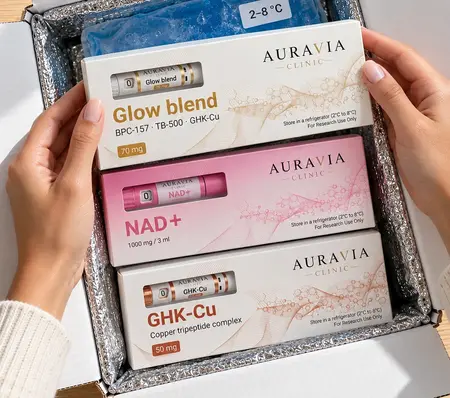
GLOW-UP Ritual
3-pen pack: Glow, NAD+, GHK-Cu

Glutathione
Antioxidant Compound

GHK-Cu
Anti-Aging Compound
GHK-Cu Pen
Pre-filled Pen GHK-Cu
Test your knowledge
Quick quiz · 6 questions
Sources and Levels of Evidence
- Grant R, Berg J, Mestayer R, et al. (2019). A Pilot Study Investigating Changes in the Human Plasma and Urine NAD+ Metabolome During a 6 Hour Intravenous Infusion of NAD+ (level of evidence: open human pilot pharmacokinetic study, n=11; PMID 31572171). Frontiers in Aging Neuroscience. (PubMed)
- Reyna E, Heinzen K, Patel S, Ritter M, Siojo R, Legere B, Pojednic R (2026). Intravenous infusion of nicotinamide adenine dinucleotide (NAD+) versus nicotinamide riboside (NR): a retrospective tolerability pilot study in a real-world setting (level of evidence: retrospective uncontrolled chart review, industry funded; PMID 41704678). Frontiers in Aging. (PubMed)
- Manufacturer-affiliated investigators (ChromaDex), NCT06382688 (2024). Randomized, placebo-controlled, pilot clinical study evaluating acute Niagen+ IV and NAD+ IV in healthy adults (level of evidence: randomized pilot, preprint, not peer reviewed, n=53 analyzed). medRxiv preprint 2024.06.06.24308565. (medrxiv.org)
- Vinten KT, et al. (2025). NAD+ precursor supplementation in human ageing: clinical evidence and challenges (level of evidence: narrative review; PMID 41083806). Nature Metabolism. (PubMed)
- Trętowicz MM, Janssens GE, Houtkooper RH, et al. (2026). Human whole-blood NAD+ levels do not vary with age or lifestyle interventions (level of evidence: multi-cohort human analytical and interventional study, seven cohorts, >300 participants). Nature Metabolism. (pure.amsterdamumc.nl)
- Covarrubias AJ, Perrone R, Grozio A, Verdin E (2021). NAD+ metabolism and its roles in cellular processes during ageing (level of evidence: mechanistic review of in vitro and animal data; PMID 33353981). Nature Reviews Molecular Cell Biology. (PubMed)
- Peluso A, Damgaard MV, Mori MAS, Treebak JT (2021). Age-Dependent Decline of NAD+: Universal Truth or Confounded Consensus? (level of evidence: critical review; PMID 35010977). Nutrients. (PMC)
- Martens CR, Denman BA, Mazzo MR, et al. (2018). Chronic nicotinamide riboside supplementation is well-tolerated and elevates NAD+ in healthy middle-aged and older adults (level of evidence: randomized, double-blind, placebo-controlled crossover trial, n=30). Nature Communications. (PMC)
- Yi L, Maier AB, Tao R, et al. (2023). The efficacy and safety of beta-nicotinamide mononucleotide (NMN) supplementation in healthy middle-aged adults: a randomized, multicenter, double-blind, placebo-controlled, parallel-group, dose-dependent clinical trial (level of evidence: randomized controlled trial, n=80; PMID 36482258; NCT04823260). GeroScience. (PubMed)
- Systematic review authors (2024). Effects of Nicotinamide Mononucleotide on Glucose and Lipid Metabolism in Adults: A Systematic Review and Meta-analysis of Randomised Controlled Trials (level of evidence: meta-analysis of randomized controlled trials). Current Diabetes Reports. (link.springer.com)
- U.S. Food and Drug Administration (2019). Amendments to the List of Bulk Drug Substances That Can Be Used to Compound Drug Products in Accordance With Section 503A: NAD considered and not proposed for inclusion (level of evidence: regulatory action, 5 September 2019). Federal Register. (federalregister.gov)
- U.S. Food and Drug Administration (2024). FDA Reminds Compounders to Use Ingredients Suitable for Sterile Compounding: adverse event reports after NAD+ injectable drugs consistent with excessive endotoxins (level of evidence: regulatory safety communication). FDA Human Drug Compounding. (fda.gov)
- U.S. Food and Drug Administration (2026). Warning Letter to GenoGenix LLC: NAD+ and 5-Amino-1MQ not eligible for section 503B exemptions (level of evidence: regulatory enforcement action, 20 January 2026). FDA Warning Letters. (fda.gov)
- McReynolds MR, Chellappa K, Baur JA (2020). Age-related NAD+ decline: human liver samples over 60 years showing approximately 30% lower NAD+ than samples under 45 years, and brain MRI studies suggesting 10% to 25% decline (level of evidence: review of human observational and imaging data). Experimental Gerontology.
- U.S. Food and Drug Administration (2026). Bulk Drug Substances Used in Compounding Under Section 503A of the FD&C Act: current category listing including NAD (level of evidence: regulatory listing). FDA Human Drug Compounding. (fda.gov)