

- The nasal route is used for peptides because it avoids the digestive tract, not because it is a reliable shortcut to the brain: for most peptides measured in humans, nasal bioavailability is around 1% or less of the injected equivalent.
- Two anatomical pathways are proposed for direct nose-to-brain transport, the olfactory and the trigeminal routes, but the olfactory region covers only a small fraction of the human nasal cavity, which limits how much of a spray can reach it.
- Semax is the peptide with the most nasal-specific data: a rat tracer study detected 0.093% of the administered radioactivity per gram of brain tissue two minutes after intranasal dosing, about 80% of it still intact peptide.
- Semax and Selank are registered as prescription nasal preparations in Russia only, on the basis of mostly small Russian-language trials. Neither has been approved by the FDA or the EMA, and neither has been evaluated in a large Western trial.
- Bremelanotide (PT-141) is the clearest cautionary case: its intranasal program was stopped in 2007 over dose-related blood pressure increases and inconsistent absorption, and the approved product is a subcutaneous injection.
- Nasal formulations add variability that injections do not have: mucociliary clearance, congestion, head position, device priming, spray technique and the chemical fragility of peptides in aqueous solution.
- This article is educational. Research peptides are not approved for human use in most jurisdictions, and nothing here should be read as a protocol.
Why do some peptides come as nasal sprays?
Peptides are fragile molecules. Swallow one and gastric acid plus intestinal proteases will usually destroy it before absorption, which is why the overwhelming majority of peptide drugs are injected. The intranasal route sits between those two extremes: it avoids the stomach entirely, it does not require a needle, and the nasal mucosa is thin, richly vascularised and directly accessible. That combination is why a handful of research peptides are sold as sprays rather than as lyophilised vials.
The nasal cavity has genuine pharmaceutical credentials. Several approved products rely on it, including desmopressin, calcitonin, nafarelin and, more recently, nasal esketamine and nasal naloxone. So the question is never whether peptides can be absorbed nasally. The question is how much, how consistently, and where the molecule ends up.
Two very different claims are often blurred together in marketing copy. The first is systemic absorption: the peptide crosses the nasal epithelium, enters the bloodstream and acts on peripheral receptors. The second is direct nose-to-brain transport: the peptide bypasses the blood-brain barrier through nerve pathways and reaches central nervous system tissue without first diluting into the whole circulation. The first is well established in principle and measurable. The second is far more contested, and the strength of the evidence varies enormously from one peptide to another.
This article separates those two claims and then walks through the peptides most often encountered as sprays: Semax, Selank, PT-141, melanotan II and oxytocin. For each one, the useful question is not whether a nasal version exists, but what has actually been measured through the nose.
Educational content only. Research peptides discussed here are not approved for human use in the European Union or the United States, and this page contains no dosing information by design. Consult a qualified healthcare professional before considering any peptide.
How could a peptide travel from the nose to the brain?
The anatomical argument for nose-to-brain delivery rests on a real peculiarity: the olfactory region of the nasal roof is the only place in the body where neurons are in direct contact with the outside environment. Olfactory sensory neurons project through the cribriform plate into the olfactory bulb, and the trigeminal nerve innervates large parts of the nasal mucosa with branches reaching the brainstem. Both are, in theory, physical conduits that skip the blood-brain barrier.
Reviews of intranasal biologics describe transport along both pathways, either inside axons or, more quickly, through the perineural and perivascular spaces that surround the nerve bundles. Material entering by the olfactory route tends to appear first in the olfactory bulb and the frontal regions, whereas the trigeminal route delivers preferentially to the brainstem, and the two pathways differ in speed. Alabsi and colleagues, reviewing therapeutic peptides delivered as nasal aerosols, treat these mechanisms as plausible and partly demonstrated in animals while stressing how much depends on formulation and on where in the nose the dose is deposited.
That last point is the practical bottleneck. In humans the olfactory epithelium covers only a small portion of the total nasal surface, high in the cavity and poorly reached by conventional spray pumps, which tend to deposit most of their volume on the anterior and respiratory mucosa. Most of what is sprayed therefore has two plausible fates: absorption into the systemic circulation, or clearance toward the throat where it is swallowed and degraded.
A further complication is interpretive rather than anatomical. If a peptide is absorbed systemically and then produces a central effect indirectly, through peripheral receptors, vagal signalling or hormonal feedback, the behavioural result can look identical to direct brain delivery while the mechanism is completely different. Distinguishing the two requires tracer studies, cerebrospinal fluid sampling or imaging, not self-reported effects. That is exactly where the literature on nasal peptides becomes thin.
How much peptide does the nasal mucosa actually absorb?
The quantitative answer from pharmaceutics is sobering. In his widely cited review of nasal delivery, Illum notes that for peptide and protein drugs measured in humans, including insulin, calcitonin, growth hormone, parathyroid hormone and desmopressin, nasal bioavailability without absorption enhancers is generally around 1% or less relative to injection. The nasal epithelium becomes a serious barrier for hydrophilic molecules above roughly 1 000 daltons, and the enzymes present in the mucosa attack peptide structures in place.
Three barriers do most of the damage. Mucociliary clearance continually sweeps the mucus layer toward the pharynx, with a clearance half-time in the region of fifteen minutes, which caps how long a dose can sit on the absorbing surface. Mucosal peptidases degrade peptides before and during transit. Tight junctions between epithelial cells restrict the paracellular route that most hydrophilic peptides would need.
Small peptides fare better than large ones, which is relevant here: Semax, Selank, oxytocin, bremelanotide and melanotan II are all well under 1 500 daltons, far smaller than insulin or growth hormone. Favourable size does not solve the clearance and enzymatic problems, but it does make low single-digit percentage absorption plausible rather than impossible, and it explains why formulation science leans on mucoadhesives, permeation enhancers, enzyme inhibitors and nanocarriers to push the numbers up.
Two consequences matter for anyone reading nasal peptide claims. First, a low percentage absorbed is not the same as no effect: highly potent peptides can be active at very low circulating concentrations, which is precisely why some nasal products work. Second, and more importantly, low bioavailability is usually accompanied by high variability. When only a small fraction crosses the mucosa, anything that changes the mucosa changes the exposure, and that instability is the recurring theme in every peptide discussed below.
What is documented for Semax by the nasal route?
Semax is the peptide for which the nasal route is not an afterthought but the original design. It is a heptapeptide analogue of the ACTH(4-10) fragment, extended with a Pro-Gly-Pro tail that slows enzymatic degradation, and it was developed in Moscow specifically as a nasal preparation. In Russia it is a registered prescription product, used mainly in cerebrovascular and cognitive indications. That registration is specific to the Russian regulatory system: Semax has never been approved by the FDA or the EMA, and no Western regulator has reviewed its dossier.
The most informative nasal-specific experiment is a tracer study by Shevchenko and colleagues, who gave rats tritium-labelled Semax intranasally and measured radioactivity in blood and brain. Two minutes after administration they detected 0.093% of the total administered radioactivity per gram of brain tissue, and approximately 80% of that radioactivity corresponded to intact Semax rather than to metabolites. The study also documented rapid degradation, with the tripeptide Pro-Gly-Pro dominating the metabolite profile. Those numbers are the quantitative backbone of the nose-to-brain claim for Semax, and they come from rats, not humans.
Human data exist but are mostly small, Russian-language and old. A clinical and electrophysiological study in the acute phase of hemispheric ischemic stroke, published by Gusev and co-workers in 1997 in around thirty treated patients, reported faster regression of general cerebral and focal deficits, especially motor ones, when intranasal Semax was added to standard intensive care. Later Russian work extended this to larger cohorts and to cerebrovascular insufficiency. None of it meets the scale, blinding standards or reporting transparency expected of a modern registration trial, and independent replication outside Russia is absent.
So the honest summary for Semax is layered. Nasal delivery of this particular peptide has measurable brain penetration in rodents, a long clinical tradition in one country, a plausible pharmacological rationale centred on neurotrophic signalling, and essentially no high-quality international human evidence. Readers comparing it with its close relative will find the distinctions set out in our Selank versus Semax comparison.
What do Selank and oxytocin add to the intranasal picture?
Selank follows the Semax template closely. It is a synthetic heptapeptide derived from the immunomodulatory fragment tuftsin, stabilised with the same Pro-Gly-Pro extension, and it is likewise registered in Russia as a prescription nasal preparation rather than as an injection. The most frequently cited clinical report, by Zozulya and colleagues in 2008, compared intranasal Selank with the benzodiazepine medazepam in 62 patients with generalised anxiety disorder or neurasthenia, 30 receiving Selank and 32 the comparator. The authors described comparable anxiolytic effects, with Selank additionally showing antiasthenic and mildly activating properties rather than the sedation typical of benzodiazepines. The full mechanistic and regulatory picture is covered in our Selank guide.
Oxytocin is the most important case study of all, because it is the only nasal peptide where the nose-to-brain question has been tested directly in humans and then argued about publicly for a decade. Striepens and colleagues sampled both plasma and cerebrospinal fluid after intranasal administration in a small group of volunteers, eleven receiving oxytocin and four placebo, and found significant increases in both compartments. The kinetics were informative: plasma concentrations peaked at around 15 minutes and declined after 75 minutes, whereas cerebrospinal fluid concentrations took up to 75 minutes to rise significantly.
That dissociation is precisely what makes the interpretation difficult. Leng and Ludwig, in a pointed critical review titled Intranasal Oxytocin: Myths and Delusions, argued that the magnitude of central exposure achieved nasally is small, that the published behavioural literature suffers from small samples and publication bias, and that enthusiasm has outrun the pharmacology. Their position is not that nasal oxytocin does nothing, but that the field needs scepticism and rigour before accepting a direct brain-delivery narrative. The debate continues, and our oxytocin research overview tracks it in detail.
The lesson generalises beyond oxytocin. If a decade of well-funded, imaging-equipped, cerebrospinal-fluid-sampling research still leaves the nose-to-brain question open for the best-studied nasal neuropeptide, then confident claims about peptides with no human pharmacokinetic data at all should be treated as marketing rather than science.
Why did PT-141 and melanotan II move away from the nose?
The melanocortin peptides tell the most instructive regulatory story in this field. Bremelanotide, better known as PT-141, began clinical life as a nasal spray. Diamond and colleagues published work in 2005 in which intranasal PT-141 was co-administered with low-dose sildenafil in a small group of men with erectile dysfunction, reporting an enhanced erectile response compared with sildenafil alone. The nasal program advanced into phase 2 in both men and women.
It was then stopped. The intranasal development was halted in 2007 over dose-related increases in blood pressure, compounded by inconsistent absorption: peak plasma concentrations and total exposure after nasal administration varied substantially between and within subjects, whereas subcutaneous dosing produced much tighter peak concentrations. Since melanocortin-4 receptor agonism can raise blood pressure, a route that produces unpredictable peaks is a poor match for the pharmacology. The product that eventually reached approval, in 2019 in the United States for hypoactive sexual desire disorder in premenopausal women, is a subcutaneous injection, not a spray.
The cardiovascular signal was then characterised properly on the injectable formulation. White and colleagues used ambulatory blood pressure monitoring in a randomised, double-blind, placebo-controlled trial of 397 premenopausal women with normotension or controlled hypertension, and detected small transient increases in ambulatory systolic pressure relative to placebo, in the order of 2 to 3 mmHg, accompanied by reductions in heart rate and with no cumulative effect over repeated daily dosing. Those are modest, manageable numbers obtained with a predictable route. The point is that the route change is what made the signal manageable.
Melanotan II sits in a weaker evidentiary position still. It is widely circulated as a nasal spray, yet there is no published human nasal pharmacokinetic dataset establishing what fraction is absorbed or how reproducible that fraction is, and the melanocortin agonist that did reach approval for photoprotection, afamelanotide, is delivered as a subcutaneous implant rather than a spray. Melanotan II also shares the melanocortin class concerns, including blood pressure and heart rate effects, nausea, and the well-documented issue of pigmented lesion changes, which argues for caution rather than for convenience. It remains an unapproved research compound.
How does the nasal route compare with injection and oral peptides?
Comparing routes properly means comparing four things at once: how much of the dose becomes available, how reproducible that figure is, how fast it happens, and what the practical and safety trade-offs are. The nasal route wins decisively on convenience and loses on reproducibility.
| Criterion | Intranasal spray | Subcutaneous injection | Oral (capsule or tablet) |
|---|---|---|---|
| Typical bioavailability for peptides | Low, commonly around 1% or less without absorption enhancers, higher for small optimised molecules | High, often near complete for small peptides | Very low for unmodified peptides, usually a fraction of a percent |
| Reproducibility between administrations | Poor to moderate: affected by congestion, mucus, technique, device state | Good: the dose reaches subcutaneous tissue regardless of mucosal condition | Poor: food, gastric pH and transit all interfere |
| Onset | Fast when absorption occurs, minutes rather than hours | Fast and predictable | Slow and often incomplete |
| Direct brain access claim | Possible via olfactory and trigeminal pathways, demonstrated in animals, contested in humans | No, depends on crossing the blood-brain barrier from blood | No |
| Main drawbacks | Variability, mucociliary clearance, local irritation, formulation instability | Needles, sterile technique, injection site reactions | Enzymatic degradation, large losses, poor predictability |
| Illustrative peptides | Semax, Selank, oxytocin, formerly bremelanotide | Bremelanotide, most research peptides | Mostly limited to specially engineered or protected formulations |
The oral column deserves a note, because it is the route most often oversold alongside sprays. Unmodified peptides taken by mouth face the harshest conditions in the body, and the engineering required to protect them, including permeation enhancers and protease inhibitors, is substantial. We cover that in depth in our analysis of oral peptide bioavailability.
Read across the table and a simple pattern appears. Injection buys precision at the cost of comfort. Nasal delivery buys comfort at the cost of precision. Oral delivery buys maximum convenience at the cost of most of the dose. Which trade-off is acceptable depends entirely on the therapeutic window of the molecule: a peptide with a wide margin tolerates variable exposure, while a peptide whose adverse effects track peak concentration, as the bremelanotide story illustrates, does not.
What are the practical limits of nasal peptide formulations?
Beyond absorption physiology, nasal peptide products carry a set of pharmaceutical problems that vials of lyophilised powder do not. The first is stability in aqueous solution. A spray is, by definition, a peptide already dissolved, and peptides in water are vulnerable to hydrolysis, oxidation, deamidation and aggregation. A powder stored cold and dry is chemically far more durable than the same peptide sitting in a pump bottle at room temperature, which is why solution products generally require refrigeration, protection from light and a defined in-use period after opening.
The second is preservation and contamination. Multi-dose nasal containers are opened repeatedly and the applicator touches the nasal mucosa, so pharmaceutical nasal products either include antimicrobial preservatives or use purpose-built preservative-free devices. Preservatives themselves are not inert: benzalkonium chloride, the most common one, has been studied for its effects on ciliary function and mucosal tolerance with prolonged use.
The third is dose delivery hardware. A metered nasal pump delivers a reproducible volume only when it has been primed, held in a consistent orientation and actuated with adequate force. Deposition pattern, droplet size and plume geometry differ between devices, and those differences change where in the nasal cavity the dose lands, which in turn changes how much is absorbed and whether the olfactory region is reached at all. Two sprays containing the same peptide at the same concentration are not interchangeable if their devices differ.
The fourth is physiological state. Rhinitis, a cold, allergy, mucosal dryness, recent nose blowing, head position and even the time of day all alter mucus volume, clearance speed and absorbing surface. This is the variability that pharmacokinetic studies capture as wide confidence intervals, and it is also the variability that makes self-assessment of a nasal peptide unreliable: the same container used on two different days may not deliver comparable exposure.
None of this makes the nasal route illegitimate. Approved nasal peptide products exist precisely because these problems can be engineered around, with controlled manufacturing, validated devices, stability testing and defined storage conditions. The caution applies specifically to unregulated research preparations, where none of those controls is documented and where neither content, sterility nor stability has been independently verified.
What do nasal spray presentations look like on the research market?
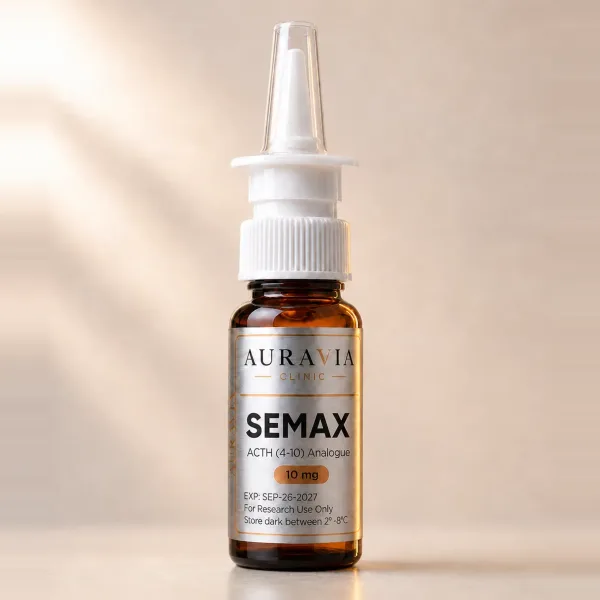
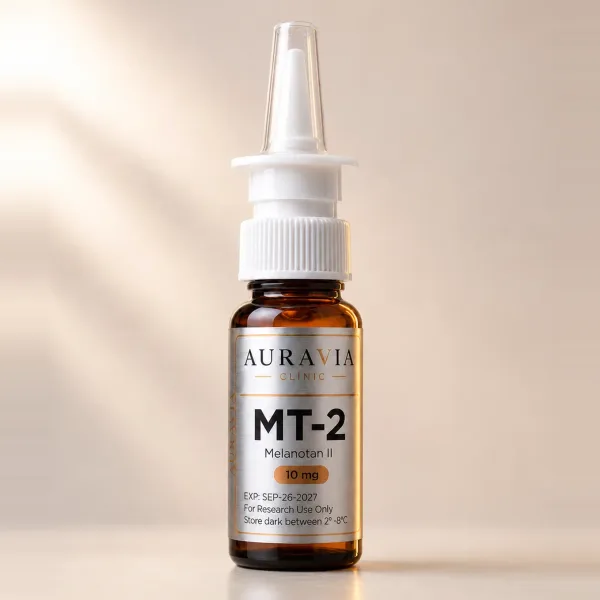
On the research supply side, only a few peptides are routinely offered in a nasal spray presentation rather than as a lyophilised vial, and they map closely onto the compounds discussed above. Two examples currently listed by AuraVia are shown below, for reference on how these items are presented and priced rather than as a recommendation to use them.
| Product | Presentation | Listed price |
|---|---|---|
| Semax Nasal Spray | 10mg nasal spray | 44.99 EUR |
| MT-2 (Melanotan II) Nasal Spray | 10mg nasal spray | 39.99 EUR |
Both are sold as research compounds, not approved medicines, and prices change over time, so the supplier page remains the only reliable reference for current pricing and stock. Regulatory status also differs by country: a compound that circulates freely as a research chemical in one jurisdiction may be a prescription-only medicine or an unauthorised product in another, and personal importation rules vary accordingly.
When evaluating any nasal peptide preparation, the questions worth asking are documentary rather than promotional. Is there a batch-specific certificate of analysis identifying the peptide and its purity, ideally with mass spectrometry and HPLC data? Is the solution composition stated, including the vehicle, any preservative and the pH? Are storage conditions and an in-use shelf life specified? Is the delivery device a metered pump with a defined delivered volume? A supplier that cannot answer those questions is selling a container, not a characterised formulation.
Readers researching sourcing and regional availability in more depth will find dedicated coverage in our articles on Semax sourcing and availability and on PT-141 sourcing and availability, which cover supplier documentation, regional regulatory status and verification practices.
Medical disclaimer. This article is for educational purposes only and deliberately contains no dosing information, no administration protocol and no therapeutic recommendation. The peptides discussed, with the exception of approved products explicitly identified as such, are research compounds that are not approved for human use by the FDA or the EMA. Legal status varies by jurisdiction. Preclinical and animal findings do not transfer reliably to humans. Consult a qualified healthcare professional before making any decision related to these compounds.
Recommended products
Research peptides selected for quality and purity:
Semax Nasal Spray
Nasal Spray Semax
MT-2 Nasal Spray
Nasal Spray MT-2

Semax
Cognitive Compound

Selank
Cognitive Compound
Test your knowledge
Quick quiz · 6 questions
Frequently Asked Questions
Do peptide nasal sprays really reach the brain?
Is a nasal spray weaker than an injection?
Why is PT-141 no longer sold as a nasal spray?
Are Semax and Selank approved medicines?
Does melanotan II work as a nasal spray?
Why are nasal peptide sprays less stable than vials?
Does a blocked nose change how much peptide is absorbed?
Are nasal peptides safer than injected peptides?
Scientific Sources
- Illum L. (2003). Nasal drug delivery: possibilities, problems and solutions. Journal of Controlled Release, 87(1-3):187-198.
- Shevchenko KV, Nagaev IY, Alfeeva LY, Andreeva LA, Kamenskii AA, Levitskaya NG, Shevchenko VP, Grivennikov IA, Myasoedov NF. (2006). Kinetics of Semax penetration into the brain and blood of rats after its intranasal administration. Russian Journal of Bioorganic Chemistry (Bioorganicheskaia Khimiia), 32(1):57-62. (PubMed)
- Alabsi W, Eedara BB, Encinas-Basurto D, Polt R, Mansour HM. (2022). Nose-to-Brain Delivery of Therapeutic Peptides as Nasal Aerosols. Pharmaceutics, 14(9):1870. (PMC)
- Striepens N, Kendrick KM, Hanking V, Landgraf R, Wüllner U, Maier W, Hurlemann R. (2013). Elevated cerebrospinal fluid and blood concentrations of oxytocin following its intranasal administration in humans. Scientific Reports, 3:3440. (PubMed)
- Leng G, Ludwig M. (2016). Intranasal Oxytocin: Myths and Delusions. Biological Psychiatry, 79(3):243-250. (PubMed)
- White WB, et al. (2017). Usefulness of ambulatory blood pressure monitoring to assess the melanocortin receptor agonist bremelanotide. Journal of Hypertension, 35(4). (PubMed)
- Zozulya AA, et al. (2008). Efficacy and possible mechanisms of action of a new peptide anxiolytic selank in the therapy of generalized anxiety disorders and neurasthenia. Zhurnal Nevrologii i Psikhiatrii imeni S.S. Korsakova. (PubMed)
- Gusev EI, et al. (1997). Effectiveness of semax in acute period of hemispheric ischemic stroke (a clinical and electrophysiological study). Zhurnal Nevrologii i Psikhiatrii imeni S.S. Korsakova. (PubMed)
- Diamond LE, Earle DC, Garcia WD, Spana C. (2005). Co-administration of low doses of intranasal PT-141, a melanocortin receptor agonist, and sildenafil to men with erectile dysfunction results in an enhanced erectile response. Urology, 65(4):755-759.